
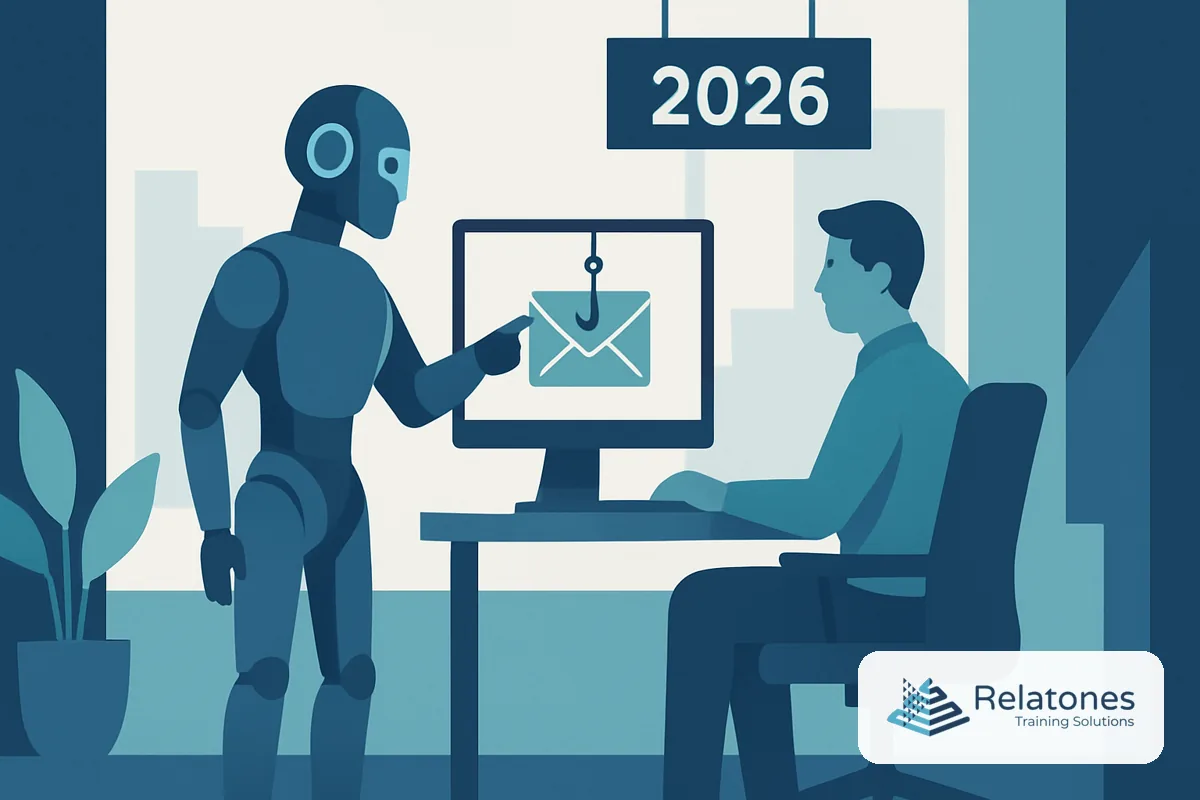
AI phishing training for employees is recurring, scenario-based security awareness training that teaches staff to recognize and verify AI-generated lures—polished emails, cloned voices, deepfake video, and scam texts—rather than relying on outdated cues like typos or off-brand logos. The problem it solves is straightforward: AI has made phishing faster, cheaper, and far more convincing, while most SMB training programs were built for a threat landscape that no longer exists. This article covers what a 2026-ready program should include, how to roll one out without an internal L&D team, and what to measure to prove it’s working. If your team’s current training amounts to “don’t click suspicious links,” you already know the gap—and you’re not alone.
Already thinking about the broader program? Start with our cybersecurity awareness training guide for the full framework, or explore our employee cybersecurity awareness training program to see how Relatones builds it for teams without internal L&D.
Why AI Phishing Training Matters Now
The threat has changed faster than most training programs have. NIST’s FISSEA forum noted in May 2026 that NIST’s FISSEA Spring Forum, May 2026, and that the federal workforce itself must move beyond static awareness toward a behavioral verification framework. If that shift is urgent for federal agencies, it’s equally urgent for the 50-to-500-employee company with no security team and a finance department approving wire transfers from a shared inbox.
The cost of getting it wrong is not hypothetical. IBM’s Cost of a Data Breach Report 2025 places the average US data breach cost at $10.22 million—a figure that can be existential for a mid-market firm even if its own loss lands well below that average. Phishing is the most common entry point, and the losses extend beyond the initial fraud into legal fees, regulatory exposure under frameworks like HIPAA and PCI DSS, downtime, and customer churn.
The upside of acting is equally concrete. KnowBe4’s 2026 benchmarking data found that organizations can reduce phishing susceptibility by 79% after one year of consistent security awareness training. That is not a marginal improvement. It’s the difference between a workforce that clicks first and asks questions later and one that pauses, verifies, and reports. CISA’s guidance for small and medium businesses reinforces the same point: teaching employees to avoid phishing is one of the highest-return security investments a small business can make.
What AI Phishing Training Should Cover in 2026
A program built only around email phishing misses most of the current attack surface. AI-powered attacks now arrive via SMS, voice calls, collaboration tools, and QR codes. Your training needs to cover all of it.
- AI-generated email lures — Polished, personalized messages that reference real projects, internal titles, or recent company events. No typos, no awkward phrasing. Employees need to verify the request, not just evaluate the writing.
- Voice cloning and vishing — Attackers clone a CEO’s or CFO’s voice to request urgent wire transfers or credential resets. The story of a finance employee who nearly wired money after a fake voicemail from their “CEO” is not hypothetical—it’s the scenario your team needs to practice.
- Deepfake video impersonation — Short video calls or clips that appear to show a known executive or vendor. Increasingly accessible to attackers and increasingly convincing.
- SMS and collaboration tool lures — Phishing that arrives in Slack, Microsoft Teams, or Google Chat, not just email. Employees are less guarded in those channels, which attackers know.
- QR code phishing — Codes embedded in print materials, emails, or meeting invites that bypass email filters entirely.
- Business email compromise (BEC) and vendor invoice fraud — Urgent payment requests that impersonate a known vendor or internal approver. Finance and HR teams need dedicated scenarios here.
For a deeper look at how social engineering underpins all of these vectors, see our related guide on social engineering awareness training.
How to Build an AI Phishing Training Program (Step by Step)
You do not need an internal L&D team to run this. A managed platform or outsourced program handles the content and simulation logistics. Your job is to provide the structure and leadership buy-in.
- Run a baseline phishing simulation — Before any training, send a simulated phishing email to your full team and measure who clicks, who reports, and who does nothing. This tells you your actual risk level and which departments need the most attention. Do not skip this step; without a baseline, you cannot prove improvement.
- Segment employees by role and risk — Finance, HR, executives, and IT help-desk staff face different attacks than general employees. Build separate learning paths. A finance manager needs deep practice on invoice fraud and wire transfer verification; a warehouse supervisor needs to recognize SMS-based credential theft.
- Deliver short, focused microlearning sessions — Keep each session to five to ten minutes and cover one attack vector at a time. A single lesson on voice cloning is more memorable than a forty-five-minute course covering everything. Deliver training where employees already work—inside Slack, Teams, or Google Chat—not in a separate portal they’ll forget to visit.
- Run recurring simulations with immediate feedback — Monthly simulations are the current recommended minimum. When an employee clicks a simulated lure, trigger a short coaching module immediately. When someone reports correctly, acknowledge it. Positive reinforcement builds a report-first culture faster than punishment builds caution.
- Teach the Stop-Phish Protocol as a behavioral default — Every employee should know one rule: when a message requests money, credentials, or sensitive data with any urgency, stop and verify through a known-good, out-of-band channel. Call the person on a number you already have. Don’t reply to the original message. This single habit—out-of-band verification—is the behavior that prevents the most expensive incidents.
- Measure behavioral metrics, not just completion — Track reporting rate, time-to-report, and correct verification behavior. Completion percentages tell you who sat through training; behavioral metrics tell you whether anything changed.
Skipping the baseline or running only annual simulations leaves you unable to measure progress and, more critically, unable to identify which teams are still at high risk. A UC San Diego study found that even after phishing awareness training, 30.8% of employees clicked a link in a simulated phishing email—a finding that underscores why frequency and immediate feedback matter more than content volume.
Assess My Team → Free. 10 minutes. No commitment.
The Stop-Phish Protocol: A Practical Framework for Every Employee
Employees do not need to become security experts. They need one reliable behavior they execute every time a request feels off. Here is a simple protocol your team can internalize in a single training session and apply immediately.
Step 1 — Pause. Do not act on any message that requests money, credential changes, or sensitive data with urgency. Urgency is the attacker’s primary lever. Recognizing it as a tactic, not a reason to rush, is the first behavioral shift.
Step 2 — Out-of-Band Check. Contact the requester through a channel you already know is legitimate. Call the vendor on the number in your records, not the one in the email. Walk to your CFO’s office. Text your colleague on the number saved in your phone. Never verify a request by replying to the request.
Step 3 — Report. Whether the request was real or fake, report it to your security team or service desk. A one-click reporting button inside your email client removes every friction point. Reporting even a real request that seemed suspicious builds the data your security team needs to identify attack patterns.
Step 4 — Document. For any transaction that gets verified, note what channel was used and who confirmed it. That paper trail protects the employee and the company if the request later turns out to have been fraudulent.
This protocol works because it bypasses the detection problem entirely. Employees do not need to identify whether an email is AI-generated—they need to verify whether the request is legitimate. That distinction is what modern AI phishing training for employees should be built around.
Pair this training with technical controls: phishing-resistant multi-factor authentication, DMARC/SPF/DKIM email authentication, and dual-approval requirements for wire transfers. Training changes behavior; technical controls reduce the blast radius when behavior falls short.
Training Delivery: Which Format Works Best
| Format | Best for | Drives behavior change? | Notes |
|---|---|---|---|
| Blended | Teams of 20+ across multiple roles | Strong | Combines async microlearning with live scenario practice; highest retention for complex behaviors like out-of-band verification |
| Live Virtual | Remote or distributed teams; executive cohorts | Strong | Real-time Q&A surfaces role-specific concerns; works well for finance and HR deep dives |
| Live In-Person | Onboarding; high-risk role groups (finance, IT) | Strong | Best for initial baseline training and high-stakes scenario walkthroughs |
| Self-Paced Only | Compliance documentation; low-risk general awareness | Limited | Completion rates look good; behavior change requires practice and feedback loops that self-paced alone cannot deliver |
Never make self-paced-only the primary format for phishing behavior change. Clicking through slides does not build the habit of pausing and verifying under pressure. If leadership isn’t included in at least one live session, your program has a gap at the top of the org chart—and executives are among the most targeted individuals in any organization.
How Relatones Approaches AI Phishing Training
Relatones starts every engagement with a baseline phishing simulation and a brief risk-segmentation review, so training is built around your team’s actual exposure rather than a generic course catalog. From there, we build role-specific learning paths—separate tracks for finance, HR, executives, and general staff—delivered inside the collaboration tools your employees already use, with monthly simulations and immediate coaching tied to each result.
We measure reporting rate and time-to-report from day one, so you have a before-and-after picture you can show leadership, auditors, or cyber insurers. The goal is a team that does not just know phishing exists but defaults to the right behavior when a convincing AI-generated lure lands in their inbox on a Tuesday morning. CMS’s Information Security and Privacy Program reinforces this direction in its 2026 cybersecurity training calendar, which lists AI, phishing, and social engineering as the core topics every employee needs to engage with this year—not once, but continuously.
Frequently Asked Questions
What is AI phishing training for employees?
AI phishing training for employees is recurring, scenario-based security awareness training that teaches staff to recognize and verify AI-generated lures—polished emails, cloned voices, deepfake video, and scam texts—rather than relying on outdated cues like typos or suspicious formatting. It pairs behavior coaching with simulated attacks so employees build real habits, not just quiz scores.
How often should employees receive phishing training in 2026?
Monthly is now the widely recommended minimum. Annual or quarterly-only training produces limited behavior change because employees forget lessons between sessions and attack techniques evolve faster than a once-a-year course can track. Short, frequent simulations with immediate feedback are far more effective at reducing susceptibility over time.
What makes AI-generated phishing harder to detect than older attacks?
AI removes the traditional red flags employees were trained to spot—poor grammar, awkward phrasing, mismatched sender names. Modern AI tools can clone a colleague’s writing style, generate a convincing voice memo from your CEO, or craft a personalized email referencing real internal projects. The attack looks and sounds exactly like a legitimate Tuesday morning request.
Which employees need the most targeted phishing training?
Finance, HR, executives, and IT help-desk staff face the highest exposure because they control wire transfers, credentials, payroll data, and system access. These roles are singled out for more sophisticated business email compromise and vendor invoice fraud. They need role-specific scenarios that mirror the actual requests they handle daily, not generic awareness content.
What should a phishing training program measure beyond click rates?
The most meaningful metrics are reporting rate—how many employees flag a suspicious message—and time-to-report, meaning how quickly they escalate it. Programs should also track correct verification behavior: did the employee use an out-of-band channel to confirm a payment request before acting? Completion rates tell you who sat through a course; behavioral metrics tell you whether it changed anything.
Your Team Is the Last Line of Defense—Train Them Like It
AI phishing attacks are not a future problem your team will eventually need to address. They are the current threat hitting finance departments, HR inboxes, and executive voicemails right now—and they look nothing like the typo-ridden emails your last training program was built around. A well-designed AI phishing training program for employees turns your workforce from potential targets into an active line of defense: people who pause, verify through a known-good channel, and report. That behavior change is measurable, achievable, and the single highest-return security investment most SMBs can make this year. Start by finding out where your team actually stands.
Assess My Team → Free. 10 minutes. No commitment.
Sources & References
Every statistic in this article is drawn from primary, US-based research. Explore the original sources below.