
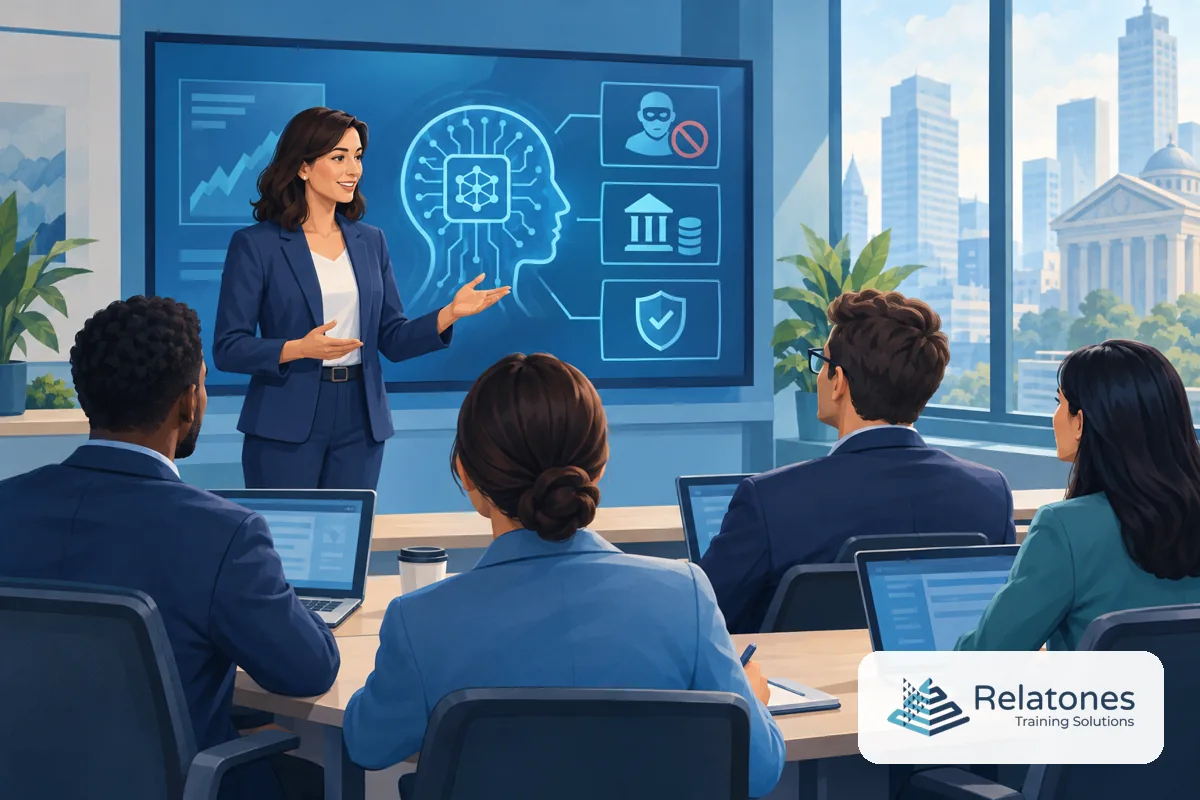
AI training for banking employees is a structured program that teaches staff to use artificial intelligence tools safely and effectively in daily banking work, covering fraud detection, AML monitoring, lending support, compliance, and customer service, while building the judgment employees need to verify outputs, protect customer data, and stay within regulatory boundaries. Without this foundation, AI becomes exactly what many institutions fear: an expensive, underutilized tool that creates more risk than it removes. This article explains what a strong program covers, how to roll one out in 90 days without an internal L&D team, and where most banking organizations are falling short right now.
New to this topic? Start with our AI training for employees guide, or explore our AI workforce training program built for teams without internal L&D.
Why AI Training for Banking Employees Matters Now
The adoption curve in banking has outpaced workforce readiness by a wide margin. Nearly two-thirds of banks rely mainly on informal, on-the-job AI learning, while only about one-third have formal programs, according to Deloitte’s Banking on Trust report. That gap matters because the consequences of unsupervised AI use in a regulated financial institution are not theoretical. Employees paste loan files into public AI tools. Customer-service staff share account details with unapproved chatbots. Loan officers rely on AI outputs without understanding whether those outputs carry fair-lending exposure.
The FDIC’s Innovation at the Speed of Markets speech describes the core challenge clearly: employees must be trained to critically evaluate AI outputs, protect sensitive data, and ensure compliance with ethical and legal standards, with human oversight built in to validate AI-generated content and decisions. For a community bank or credit union operating with 50 to 500 employees and no dedicated compliance-training function, that standard is hard to meet without outside help.
The U.S. Treasury’s report on AI-specific cybersecurity risks in financial services identifies regulatory fragmentation and a shortage of AI-risk skills in legal and compliance teams as significant challenges for smaller institutions. Those firms face the same supervisory expectations as large banks but lack the model-risk, governance, and L&D infrastructure to meet them. The practical result: when regulators examine how a bank supervised its AI use, the institution needs documented training evidence, not just a policy document sitting in a shared drive.
Cyber incidents tied to AI systems add financial pressure on top of regulatory pressure. Research published through PMC on AI adoption in banking notes that cyber threats in this space resulted in financial losses of $110 million in a single period. IBM’s Cost of a Data Breach Report 2025 puts the average US data breach cost at $10.22 million. Neither figure is survivable for a mid-sized community institution without adequate controls and trained staff behind them.
What AI Training for Banking Employees Should Cover
A role-based program needs to go well beyond “here is what ChatGPT can do.” The content must connect directly to the work employees perform every day and to the controls their institution is expected to maintain.
- AI fundamentals - What generative AI is, how it differs from predictive models and AI agents, what hallucinations are, and why outputs always require human judgment before being acted on.
- Approved tool usage - Which tools the institution has authorized, what data may enter each one, and what happens when employees use unapproved tools with customer information.
- Data protection - Prohibited inputs including nonpublic personal information, loan files, authentication credentials, and proprietary data, plus vendor-retention risks when using cloud-based AI services.
- Safe prompting - How to write effective prompts using approved context, how to constrain output scope, and how to verify that sources cited by the AI actually exist.
- Human oversight and escalation - When independent verification is required, how to handle adverse-action situations, and which decisions may never be delegated to an unapproved tool.
- Cybersecurity threats specific to AI - Deepfake voice calls targeting wire transfers, prompt injection attacks, AI-generated phishing emails, and fraudulent instructions that appear to come from internal systems.
- Manager responsibilities - How supervisors review AI use cases, monitor adoption, handle incidents, and prevent employees from bypassing controls under time pressure.
For related guidance on AI governance controls that support these training objectives, explore our article on AI governance training for employees.
How to Roll Out AI Training in 90 Days
A phased approach lets a small institution build controlled capability without overwhelming a team that is also handling daily operations.
- Inventory tools and assess risk (Days 1-10) - List every AI tool currently in use, whether approved or not. Classify each by data sensitivity and business function. This inventory becomes the foundation for your acceptable-use policy and training assignments.
- Publish an acceptable-use standard (Days 11-20) - Define approved tools, prohibited data types, permitted use cases, human-review requirements, recordkeeping obligations, and incident-reporting procedures. Training without a policy gives employees nothing concrete to follow.
- Select a provider and assign foundational training (Days 21-30) - Choose a managed training provider with banking-specific content, a learning management system that tracks completions and assessment scores, and the ability to generate audit reports. Assign foundational AI literacy to all employees.
- Deliver role-specific workshops (Days 31-60) - Run facilitated virtual sessions for lending, operations, compliance, fraud, and customer service. Use realistic exercises: summarizing approved documents, drafting customer communications under data constraints, checking AI outputs for accuracy, and escalating questionable results. Live practice is critical for judgment-heavy topics.
- Assess, measure, and adjust (Days 61-90) - Review completion rates, assessment scores, reported incidents, tool adoption, and manager feedback. Identify which roles need additional reinforcement before access to higher-risk tools is expanded.
Skipping the policy and inventory steps before training begins creates a situation where employees finish a course but have no clear rules to follow at their desks. Completion rates look good on a dashboard while actual risk behavior goes unchanged.
Assess My Team → Free. 10 minutes. No commitment.
A Practical Framework for Sustained AI Competency
A single course is not a program. The institutions that successfully reduce AI-related incidents treat training as an ongoing operational control, not a one-time event. The following framework applies whether you are starting from scratch or improving an existing approach.
Governance first. Assign a small group with representatives from compliance, information security, risk, IT, HR, and operations. This group owns the approved-tool register, the acceptable-use policy, escalation paths, and training update schedules. Without this structure, training content drifts out of alignment with actual tool use.
Role-based pathways, not department-wide courses. A teller, a loan processor, a fraud analyst, and a compliance officer face different AI risks and need different skills. The Treasury’s guidance on AI use in financial services supports role-based capability mapping over generic training for exactly this reason. Build pathways for at least these groups: frontline staff, lending and credit, operations, fraud and AML, compliance and legal, managers, and IT or technical staff.
Documented assessments as audit evidence. Knowledge checks, scenario scores, policy attestations, and retraining dates belong in a learning management system where they can be pulled for examiner review. A Deloitte analysis of AI in banking describes competency evidence as a core element of responsible AI governance, not a nice-to-have.
Continuous reinforcement. Brief monthly refreshers on new threats or policy changes, quarterly scenario exercises, and mandatory updates whenever a tool or regulation changes keep knowledge current. The NCUA’s AI guidance for credit unions points institutions toward NIST’s AI risk management resources as a framework for structuring ongoing governance and training review.
Measure behavior, not just completion. The real question is not whether employees finished the course. It is whether the number of shadow AI incidents dropped, whether escalation quality improved, and whether prohibited-data events are being reported. Track completion, assessment performance, incident counts, approved-tool adoption, and audit findings each quarter.
Delivery Format Comparison
| Format | Best for | Drives behavior change? | Notes |
|---|---|---|---|
| Blended | Full program rollout across roles | Strong | Combines self-paced fundamentals with live practice; best fit for a 90-day rollout |
| Live Virtual | Role-specific workshops, scenario exercises | Strong | Effective for judgment-heavy topics like fair lending, escalation, and fraud response |
| Live In-Person | Leadership cohorts, pilot groups at a single location | Strong | High engagement but harder to scale across branches or hybrid teams |
| Self-Paced | Foundational AI literacy, policy acknowledgment | Limited | Useful for initial awareness; insufficient alone for behavior change in regulated roles |
How Relatones Approaches AI Training for Banking Teams
Relatones starts by assessing which roles are using AI, which tools are in play, and where the gaps between current behavior and institutional policy are largest. From that baseline, we build role-based training pathways that connect directly to your approved tools and your specific compliance obligations, whether those involve fair lending, CCPA/CPRA data handling, or AML monitoring controls. Training is not generic: a loan processor works through different scenarios than a fraud analyst or a branch manager.
Each program includes facilitated virtual workshops that require employees to practice on realistic banking scenarios, not abstract prompts, followed by scenario-based assessments that produce the documented evidence your compliance team needs for examiner review. Reinforcement is built into the schedule from day one, with brief monthly updates tied to tool and policy changes. The outcome is a team that uses AI with consistent judgment, escalates correctly, and leaves an auditable record behind every significant decision.
Frequently Asked Questions
What should AI training for banking employees actually cover?
A solid program covers AI fundamentals, approved tool usage, data protection rules for customer and nonpublic personal information, safe prompting, human oversight requirements, cybersecurity threats like deepfakes and prompt injection, and role-specific practice for lending, operations, fraud, compliance, and customer service. One-time awareness sessions are not enough. Employees need scenario-based exercises tied to their actual workflows and documented assessments that serve as audit evidence.
Why is generic AI training a problem for banking teams?
Generic training teaches employees what AI is but not how to use it safely within banking constraints. A loan officer needs guidance on fair lending and explainability. A customer-service rep needs rules for chatbot outputs. A compliance analyst needs model documentation skills. When training ignores these distinctions, employees either avoid AI entirely or use it in ways that create regulatory and data-privacy exposure.
How does AI training reduce fraud and AML risk in banking?
Training helps employees recognize when AI fraud-detection outputs require human review, understand the limits of automated AML flags, and avoid feeding sensitive transaction data into unapproved tools. It also covers AI-enabled social engineering threats, such as deepfake voice calls and AI-generated phishing emails, which are increasingly used to bypass banking controls. Employees who understand these threats catch more incidents and escalate faster.
How often should banking employees receive AI training?
AI tools, threats, and regulations change quickly enough that a one-time course is insufficient. A practical schedule combines foundational training for all staff, role-specific workshops during the first 90 days, brief monthly reinforcement on new threats or policy changes, and a full refresh whenever the institution adopts a new AI tool or a significant regulatory guidance is issued.
Can a small bank or credit union build an AI training program without an internal L&D team?
Yes. The most practical path is to work with a managed training provider that supplies role-based content, a learning management system with completion tracking, and facilitated virtual workshops. This eliminates the need to hire curriculum designers or compliance writers. The institution still needs to assign a governance group, approve a tool register and acceptable-use policy, and review content for accuracy before deployment.
Start Before the Regulator Asks
A supervised, documented AI training program is no longer optional for banking organizations. The institutions that are building these programs now are reducing shadow AI incidents, producing audit-ready completion records, and giving frontline employees the judgment to use AI tools without creating the data or fair-lending exposure that leads to enforcement. The institutions that are waiting are accumulating risk they cannot easily measure until an examiner asks to see it. Use the free assessment below to identify where your team’s gaps are largest and what a targeted program would look like.
Assess My Team → Free. 10 minutes. No commitment.
Sources & References
Every statistic in this article is drawn from primary, US-based research. Explore the original sources below.
- 1Innovation At The Speed Of Markets: How Regulators Keep Pace With Technology
- 2Banking on Trust
- 3AI in Banking
- 4U.S. Department of the Treasury Releases Report on Managing Artificial Intelligence-Specific Cybersecurity Risks in the Financial Sector
- 5Treasury Releases Two New Resources to Guide AI Use in the Financial Sector
- 6Artificial Intelligence (AI)
- 7Adoption of artificial intelligence and machine learning in banking systems: a qualitative survey of board of directors