
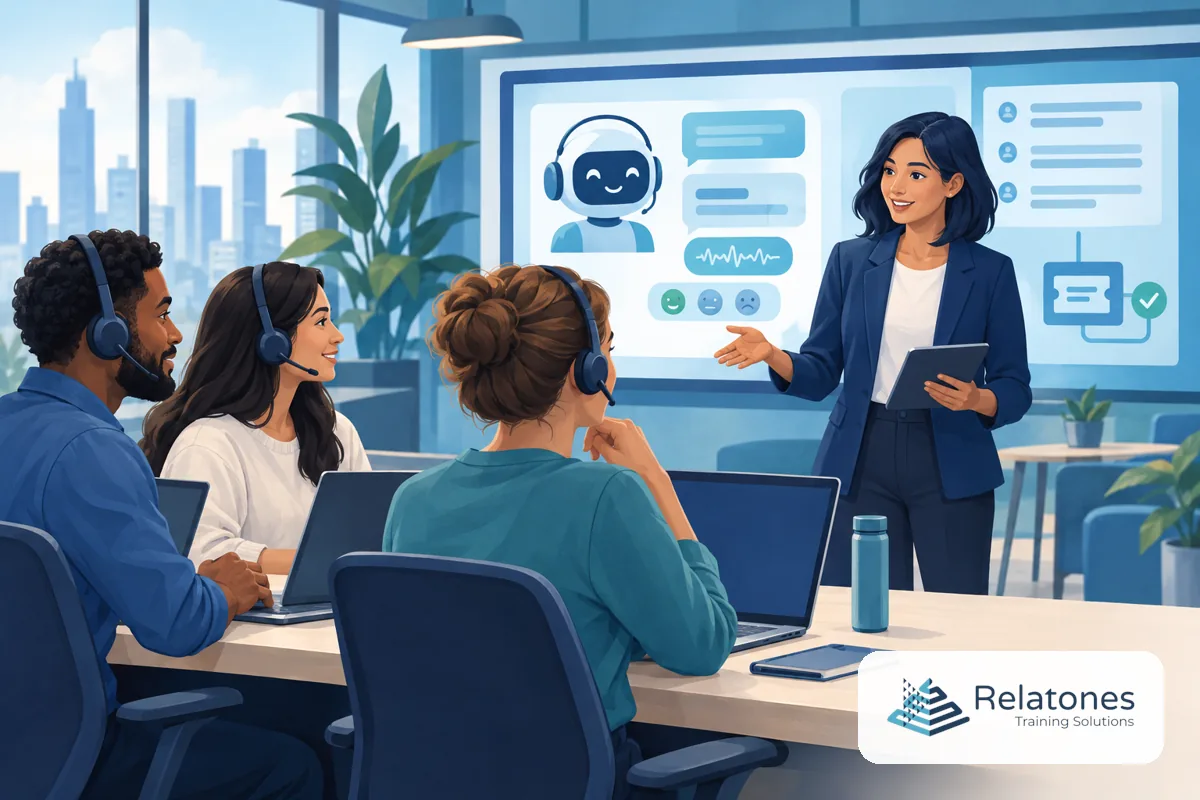
AI training for customer service teams is a structured program that teaches agents to use AI tools, such as copilots, ticket summarization, and knowledge-base search, accurately and safely within real service workflows. Without it, teams that adopt AI tools often see inconsistent adoption, inaccurate answers going out to customers, and privacy risks as agents paste sensitive data into unapproved tools. This article covers what a practical program should include, how to roll one out in 30 to 90 days, and how to measure whether it actually changed behavior. If your team is already using AI tools but hasn’t formally trained anyone on them, the gap between adoption and capability is probably costing you in ways that don’t show up on a single report.
New to AI workforce readiness? Start with our AI training for employees guide, or explore our AI workforce training program to see how Relatones structures role-specific instruction for customer-facing teams.
Why AI Training for Customer Service Teams Matters Now
Customer service was one of the first business functions to absorb AI tools at scale, and adoption has moved faster than the training to support it. According to McKinsey’s November 2025 AI Global Survey, 88 percent of companies had adopted at least one AI tool. But widespread access to tools is not the same as knowing how to use them well. Many customer service teams are running AI-assisted workflows without clear prompting standards, verification steps, or escalation rules.
The business risks are concrete. An agent who accepts an AI-generated answer without checking it against a policy document or account record can send a customer incorrect information about a refund, a plan benefit, or an eligibility date. The FDIC’s Innovation at the Speed of Markets speech highlights that employees need training to critically evaluate AI outputs and protect sensitive data, not just the ability to log into a tool. That principle applies equally to a 75-person insurance company and a federal agency.
There is also a real upside when training is done properly. Teams that train on specific use cases, rather than generic AI awareness, see faster response times, more consistent tone, and fewer repeat contacts. The GSA’s AI Guide for Government notes that organizations building strong AI programs explicitly identify skill gaps and provide targeted training, rather than leaving adoption self-directed. The same principle applies to SMBs: structured, role-specific instruction produces measurable results; a one-time video course usually does not.
What AI Training for Customer Service Teams Should Cover
A solid program goes beyond “here is how to open the tool.” It builds the judgment agents need to decide when to use AI, how to verify what it produces, and when to stop and escalate.
- AI fundamentals - What the tool can and cannot do, how it generates answers, what hallucination means in practice, and when AI confidence should not be trusted without verification.
- Prompting for service work - How to supply customer context, policy constraints, desired tone, and format so the AI produces a useful draft rather than a generic one.
- Output verification - Checking every consequential answer against an authoritative source, including policy documents, account records, and knowledge-base articles, before sending it to a customer.
- Privacy and data hygiene - Which customer data fields are approved for use in AI tools, what cannot go into a prompt (payment details, health information, authentication credentials), and how to report a potential data incident.
- Escalation thresholds - Clear rules for when a human must take over: fraud indicators, vulnerable customers, regulated advice, disputes, and account changes beyond the AI’s authority.
- Responsible use and disclosure - How to document AI-assisted interactions, when to disclose AI involvement to a customer, and how to report a potentially biased or discriminatory output.
- Workflow integration - How the AI tool connects to the help desk, CRM, and knowledge base, rather than treating it as a separate system agents check separately.
For teams operating in regulated industries, the CMS guidance on responsible AI use is a useful reference: users are responsible for the accuracy of all content produced with AI tools, and documentation of that review is required.
How to Build an AI Training Program for Customer Service (Step by Step)
The most effective programs start small, measure results, and expand only after quality is stable.
- Survey your team’s current AI use - Ask agents which tools they are already using, what they are using them for, and what concerns they have. You will likely find informal, inconsistent adoption that needs structure before it scales.
- Pick one or two low-risk use cases - Good starting points include AI-drafted replies for routine questions, ticket summarization, and knowledge-base search. Avoid starting with use cases that involve account changes, payment processing, or regulated advice.
- Establish a one-page acceptable-use standard - Before training begins, publish which tools are approved, which customer data fields can be used in prompts, and what the escalation rules are. This becomes the reference document for the training itself.
- Record baseline metrics - Capture handle time, first-contact resolution, quality-assurance scores, escalation rate, and customer satisfaction before training starts. You cannot demonstrate ROI without a pre-training baseline.
- Run a live workshop with supervised practice - A 60 to 90-minute live session, followed by agents completing actual tasks on sanitized tickets, is more effective than self-paced video alone. Train a small pilot group first, including both experienced and newer agents.
- Appoint two or three AI champions - Champions test prompts, build a shared prompt library, answer peer questions, and flag problems before they become patterns. This is the fastest way to scale without a dedicated L&D team.
- Coach in the workflow weekly - Team leads should review a sample of AI-assisted interactions each week, focusing on factual accuracy, tone, policy compliance, and appropriate escalation, not just completion rates.
- Certify through scenario-based checks - Agents should demonstrate proficiency by completing realistic scenarios, not by finishing a video. Scenario-based certification gives you evidence that behavior actually changed.
Skipping the baseline measurement step and the practice component are the two most common mistakes. Without a baseline, you cannot connect training to business outcomes. Without practice on real workflows, agents often revert to old habits within two weeks.
Assess My Team → Free. 10 minutes. No commitment.
A Practical 30-60-90 Day Rollout Framework
This framework is designed for a team of 10 to 50 agents without an internal L&D function.
Days 1 to 30: Define and pilot. Survey current AI use and confidence levels. Select one or two low-risk use cases. Write the acceptable-use standard. Record baseline metrics. Train a pilot group of five to ten agents through a live workshop plus supervised ticket practice. Build a first prompt-and-example library.
Days 31 to 60: Coach and improve. Review AI-assisted interactions weekly. Collect agent feedback on which suggestions are useful, misleading, or missing. Correct prompts, knowledge articles, and escalation rules based on what you find. Do not expand to the wider team until quality in the pilot group is stable.
Days 61 to 90: Scale and govern. Train the wider team, using pilot agents as peer coaches. Certify agents through scenario-based checks. Publish version-controlled prompts, approved use cases, prohibited uses, and escalation paths. Reassess outcome metrics at 30, 60, and 90 days and report results to leadership.
The U.S. Treasury’s guidance on AI risk management for financial institutions notes that effective governance requires embedding accountability and transparency into AI deployment decisions at every stage. That standard translates directly to customer service: an agent who does not know the escalation rules, the data boundaries, or the verification requirements is a governance gap, not just a training gap.
Delivery Format Comparison
| Format | Best for | Drives behavior change? | Notes |
|---|---|---|---|
| Blended | Most SMB service teams | Strong | Short live session plus weekly workflow labs produce the best retention and adoption. |
| Live Virtual | Distributed or multi-shift teams | Strong | Effective when sessions include real ticket practice, not just slides and Q&A. |
| Live In-Person | Collocated teams, complex use cases | Strong | Best for high-stakes workflows where real-time coaching matters most. |
| Self-Paced | Awareness refreshers only | Limited | Useful as a supplement; not effective as the primary format for behavior change. |
How Relatones Approaches AI Training for Customer Service Teams
Relatones starts with a team assessment to identify which AI tools agents are already using, which workflows carry the most risk, and where the gaps between current behavior and required standards are largest. From there, we build role-specific instruction for agents, team leads, and supervisors, covering prompting, verification, privacy, escalation, and workflow integration within the team’s actual tools and ticket types. Training is delivered through live sessions followed by applied practice on sanitized, representative tickets, not generic scenarios. Champions are identified and coached first so they can sustain the program after launch. We track adoption, quality-assurance scores, and outcome metrics through the first 90 days so leadership has evidence of what changed and what still needs attention. The result is a team that uses AI tools consistently, accurately, and within the boundaries your policies and customers require.
Frequently Asked Questions
What is AI roleplay for customer service?
AI roleplay for customer service is a training method where agents practice handling simulated customer conversations using AI tools, including realistic emotional scenarios, complaint handling, and escalation decisions. The goal is to build muscle memory around prompting, verifying AI outputs, and knowing when to take over from the AI before those moments happen in production. Simulations that use representative ticket types from the team’s actual work are significantly more effective than generic scenario libraries.
What can customer service teams practice with AI roleplay?
Teams can practice drafting replies with an AI copilot, summarizing long tickets, routing complex cases, handling emotionally charged conversations, applying escalation rules, and checking AI-generated answers against knowledge-base sources. The Georgia Office of Artificial Intelligence’s guidance recommends that employees record queries and responses outside of AI tools for tracking and auditing purposes, a habit worth building into practice simulations from the start.
How quickly do agents see results from AI coaching?
Most teams see measurable changes in handle time, first-contact resolution, and quality scores within 30 to 60 days of a structured pilot, provided agents practice on real workflows rather than just completing video modules. Results depend on the number of use cases introduced, the quality of practice sessions, and how consistently supervisors review AI-assisted interactions. Generic awareness training alone rarely moves the metrics.
Is AI training suitable for all levels of customer service staff?
Yes. Front-line agents, team leads, quality analysts, and supervisors each need a version of AI training, but the content differs. Agents focus on prompting, verification, and escalation. Team leads focus on coaching AI-assisted interactions and reviewing accuracy. Supervisors and analysts focus on governance, metrics, and policy compliance. IBM’s analysis of AI adoption challenges finds that nearly 80 percent of executives expect AI to drive significant revenue by 2030, but only 24 percent know where it will come from, which suggests that leadership alignment around use cases and measurement is as important as front-line skill building.
How do you measure whether AI training for customer service actually worked?
Track both productivity and customer risk metrics: AI-assisted interaction adoption rate, time to first response, average handle time, first-contact resolution, quality-assurance accuracy, hallucination and rework rates, and customer satisfaction scores. Training that reduces handle time while increasing inaccurate answers or complaints is not a success. Set a 90-day measurement window and compare results against the baselines you recorded before training began.
Build the Skills Before the Risk Finds You
Customer service teams are already using AI tools in ways that create real exposure: inaccurate answers reaching customers, sensitive data entering unapproved systems, and escalations that should have happened not happening. Structured AI training for customer service teams closes those gaps before they become complaints, incidents, or regulatory notices. Start with a team assessment to find out where your current practices stand.
Assess My Team → Free. 10 minutes. No commitment.
Sources & References
Every statistic in this article is drawn from primary, US-based research. Explore the original sources below.
- 1The Biggest AI Adoption Challenges for 2026
- 2Innovation At The Speed Of Markets: How Regulators Keep Pace With Technology
- 3Treasury Releases Two New Resources to Guide AI Use in the Financial Sector
- 4Guidance for State Organizations
- 5AI Guide for Government
- 6Guidance for Responsible Use of Super Intelligence (SI) at CMS