
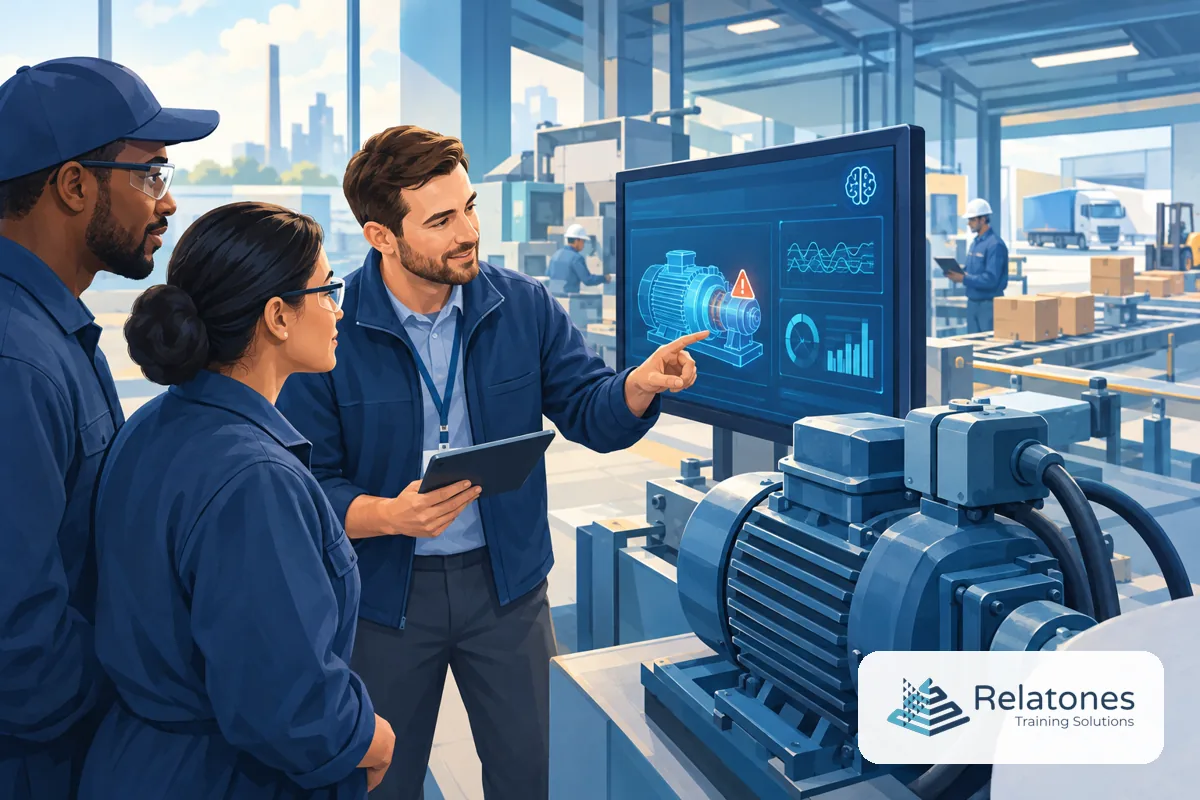
AI training for manufacturing workers is practical workforce education that teaches employees how to use, interpret, and safely supervise AI-enabled tools in daily production, without requiring them to become programmers or data scientists. As predictive maintenance systems, computer vision quality checks, and AI-assisted supply chain tools move from pilot projects to standard equipment on the shop floor, workers need enough understanding to validate what the system recommends, recognize errors, and know when to escalate. The gap between AI adoption and workforce readiness is widening fast, and for US manufacturers with 50 to 500 employees, that gap carries real operational and financial risk. If your team has started using AI tools but has not yet built a structured training program, you are not alone and you are not too late.
New to this topic? Start with our AI training for employees guide, or explore our AI workforce training program built for teams without an internal L&D department.
Why AI Training for Manufacturing Workers Matters Now
Adoption is running well ahead of readiness. According to NIST’s manufacturing resource, more than 80% of manufacturers expect to increase their AI use in the next two years, yet most of those same companies have not built formal training programs to prepare workers for the transition. That combination creates a specific kind of operational risk: workers operating AI-enabled equipment they do not fully understand, following recommendations they cannot verify, in environments where a wrong call can stop a line or create a safety incident.
The skills shortage compounds the problem. Joint research by Deloitte and the Manufacturing Institute shows that nearly 1.9 million US manufacturing jobs could go unfilled by 2033 if skills gaps are not addressed. Meanwhile, verbatim buyer language circulating in the industry acknowledges that manufacturers will need to fill as many as 3.8 million jobs over the next decade as experienced workers retire and AI changes what remaining roles require. The workers who stay need new capabilities quickly.
The upside of acting is concrete. Workers who have a clear path to new skills are reported to be significantly less likely to quit than those without one, which matters for manufacturers already dealing with recruiting costs and turnover disruption. And NIST’s manufacturing data shows that 55% of manufacturers see AI as a game-changing technology for competitiveness, meaning the question is not whether AI will shape your workforce but whether your team will be ready when it does.
What AI Training for Manufacturing Workers Should Cover
A strong program is not a generic “intro to AI” course. It is role-specific instruction tied to the actual tools, workflows, and safety requirements in your facility. Here are the core areas every manufacturing AI training program should address:
- AI basics and tool literacy - What AI can and cannot do, how predictive models generate recommendations, and why outputs require human review rather than automatic acceptance.
- Data interpretation - How to read AI-generated alerts, maintenance scores, or quality flags; how to distinguish a confident prediction from an uncertain one; and how to document what the system said versus what the worker decided.
- Responsible and safe use - Which tools are approved, what data must never be entered into a public AI system, and how to report incorrect or unsafe AI output without penalty.
- Predictive maintenance concepts - How the system monitors equipment health, what a maintenance alert means in practice, and when a technician must override the recommendation and lock out the machine.
- Quality inspection and supply chain applications - How computer vision systems flag defects, how AI-assisted procurement tools work, and how to validate outputs before releasing product or placing orders.
- Escalation and human override rules - Specific, documented procedures for when workers must stop, escalate, or override AI recommendations, particularly for safety-critical or quality-release decisions.
For a broader look at how to structure foundational AI skills across your entire workforce, see our guide to AI literacy training for employees.
AI Training for Manufacturing Workers: 5 Practical Steps
Starting a program without a dedicated L&D team is manageable if you keep the initial scope tight and build from results. Skipping these steps, particularly the baseline assessment and supervisor preparation, is the most common reason pilots stall.
-
Audit your data and systems first - Ask what operational data you already collect, whether it is captured manually or digitally, and whether your production, maintenance, and quality systems can communicate with each other. Training workers on AI tools that have no clean data to work with produces frustration, not results.
-
Define two or three priority use cases - Choose high-frequency problems where AI assistance has a measurable payoff: unplanned downtime, quality escapes, slow maintenance troubleshooting, or difficulty locating work instructions. Narrowing the scope early gives the pilot a clear success metric.
-
Train supervisors before frontline workers - Supervisors control whether workers get the time, permission, and psychological safety to practice new skills. If supervisors do not understand the tools and cannot model correct use, frontline adoption will stall regardless of how good the curriculum is.
-
Deliver role-specific modules in short sessions - Operators, maintenance technicians, quality staff, and office personnel all need different instruction. Ten to twenty-minute modules delivered before or after shifts minimize production disruption while covering the skills each role actually needs.
-
Measure operational outcomes, not just completion - Track maintenance troubleshooting time, first-pass yield, quality escapes, and worker confidence before and after training. If the operational numbers do not move within ninety days, review whether the training is role-specific enough or whether system access is blocking real practice.
Skipping the baseline audit in step one is particularly costly. Workers trained on AI tools they cannot use because of data gaps or legacy-system integration problems will disengage and associate AI with wasted time rather than useful support.
Assess My Team → Free. 10 minutes. No commitment.
A Practical Framework: Assess, Train, Practice, Reinforce, Measure
The most defensible and effective programs follow a consistent cycle rather than treating AI training as a one-time software rollout.
Assess before you build. Survey workers and supervisors by role. Identify baseline familiarity with your existing AI or digital tools, and document the specific decisions workers make daily where an AI recommendation could help or harm. This assessment takes a few days and prevents you from buying curriculum your team does not need.
Build a short common foundation. Every worker who touches AI-enabled equipment should complete a shared module covering what AI is, how it makes recommendations, hallucinations and verification, approved tool use, data privacy, and escalation procedures. This takes roughly two to three hours and can be delivered in short sessions over one or two weeks.
Add role-specific pathways. Maintenance technicians need hands-on practice interpreting predictive maintenance alerts and validating recommendations against physical inspection. Operators need instruction on work instructions, defect reporting, and safe use of voice or visual AI assistants. Quality staff need to understand inspection-data analysis and human approval requirements before any AI-flagged disposition is accepted. Supervisors need coaching on reviewing outputs, reinforcing correct behavior, and managing change.
Reinforce through supervised practice. Pair each module with a practice exercise using approved, non-sensitive data or a controlled sandbox. Put searchable, current work instructions and “how to verify AI output” job aids where employees actually work, not in a learning management system they access once a year.
Measure and adjust. Review operational metrics monthly during the pilot. Worker confidence surveys and near-miss reports provide leading indicators before lagging metrics like downtime or scrap rates reflect the change.
This cycle connects training directly to the AI workforce training program Relatones builds for manufacturers without internal L&D teams.
Delivery Format Comparison
| Format | Best for | Drives behavior change? | Notes |
|---|---|---|---|
| Blended | Most manufacturing teams; combines online modules with supervised shop-floor practice | Strong | Minimizes line disruption while ensuring hands-on application |
| Live Virtual | Supervisor cohorts, role-specific workshops, change management sessions | Strong | Works well for technicians and engineers who can attend scheduled sessions |
| Live In-Person | Safety-critical overrides, lockout/tagout integration, hands-on equipment scenarios | Strong | Best for high-stakes skills that require direct observation and sign-off |
| Self-Paced | Foundational AI literacy modules as a first step | Limited | Completion does not equal competency; must be followed by supervised practice |
Self-paced modules alone are not sufficient for behavior change in manufacturing environments where incorrect AI use carries safety or quality consequences.
How Relatones Approaches AI Training for Manufacturing Workers
Relatones starts with an assessment of your current workflows, the AI tools your team is using or preparing to use, and the operational gaps where training will produce a measurable result. From there, we build role-specific pathways for operators, maintenance technicians, quality staff, and supervisors rather than putting everyone through the same generic content. Each pathway includes foundational AI literacy, hands-on practice exercises tied to your actual processes, documented human-override rules, and supervisor coaching so reinforcement happens on the floor, not just in a training session. We track operational outcomes alongside completion, so you can show leadership a business result, not just a certificate. The outcome is a team that can interpret AI recommendations with confidence, recognize when something looks wrong, and escalate appropriately before a small error becomes a line stoppage or a safety incident.
Frequently Asked Questions
What data should we assess before starting AI training for manufacturing workers?
Start by asking what operational data you already collect: downtime logs, quality inspection records, maintenance work orders, and production throughput. Determine whether that data is captured manually or digitally and whether your systems can share it with an AI tool. Workers trained on AI tools they cannot actually use because of data or integration gaps will disengage quickly. A short baseline audit of your data environment is a practical first step before selecting any training content.
Do manufacturing workers need to learn to code or become data scientists?
No. Most shop-floor roles require AI literacy, not AI engineering. Workers need to understand what an AI system is recommending, recognize when that recommendation looks wrong, know when to escalate, and follow your company’s rules for approved tools and data use. Operators, maintenance technicians, and quality staff all need role-specific skills built on that foundation, not programming knowledge.
How do we train workers without shutting down the production line?
Short, role-specific modules delivered in ten to twenty minutes work well before or after shifts, or during natural breaks in the workflow. Blended formats that combine brief online lessons with supervised hands-on practice during scheduled downtime reduce the need to pull entire crews off the line. Training supervisors first also helps because they can then reinforce learning during regular work without requiring separate classroom sessions.
Which AI solutions can be used across multiple areas of a manufacturing company?
Natural language processing tools can support operators with voice-activated controls, maintenance technicians with procedure searches, and supervisors with documentation. Computer vision systems apply to quality inspection, safety monitoring, and inventory management. Predictive maintenance platforms draw on sensor data relevant to both maintenance and production planning. Rather than buying separate tools for each department, assess which problems recur most often across roles and look for platforms that address more than one of them.
How do we measure whether AI training is actually working?
Track operational outcomes, not just course completion rates. Useful metrics include maintenance troubleshooting time before and after training, first-pass yield and rework rates, the number of quality escapes, time workers spend locating procedures, and supervisor observations of correct AI tool use. Worker confidence surveys and near-miss reports also provide leading indicators. If the numbers do not move within ninety days of a pilot, review whether training is role-specific enough or whether data and system access are blocking practical use.
Build a Program That Keeps Your Line Running and Your Team Ready
The manufacturers that fall behind on AI are rarely the ones that refused to adopt the technology. They are the ones that deployed AI tools without preparing their workers to use them safely and confidently. A role-specific training program tied to your real workflows is not a large investment relative to the cost of a single unplanned production stoppage or quality escape. Start with a skills assessment, run a focused pilot on one line or one maintenance group, and measure what changes. That evidence then makes the case for scaling.
Assess My Team → Free. 10 minutes. No commitment.
Sources & References
Every statistic in this article is drawn from primary, US-based research. Explore the original sources below.