
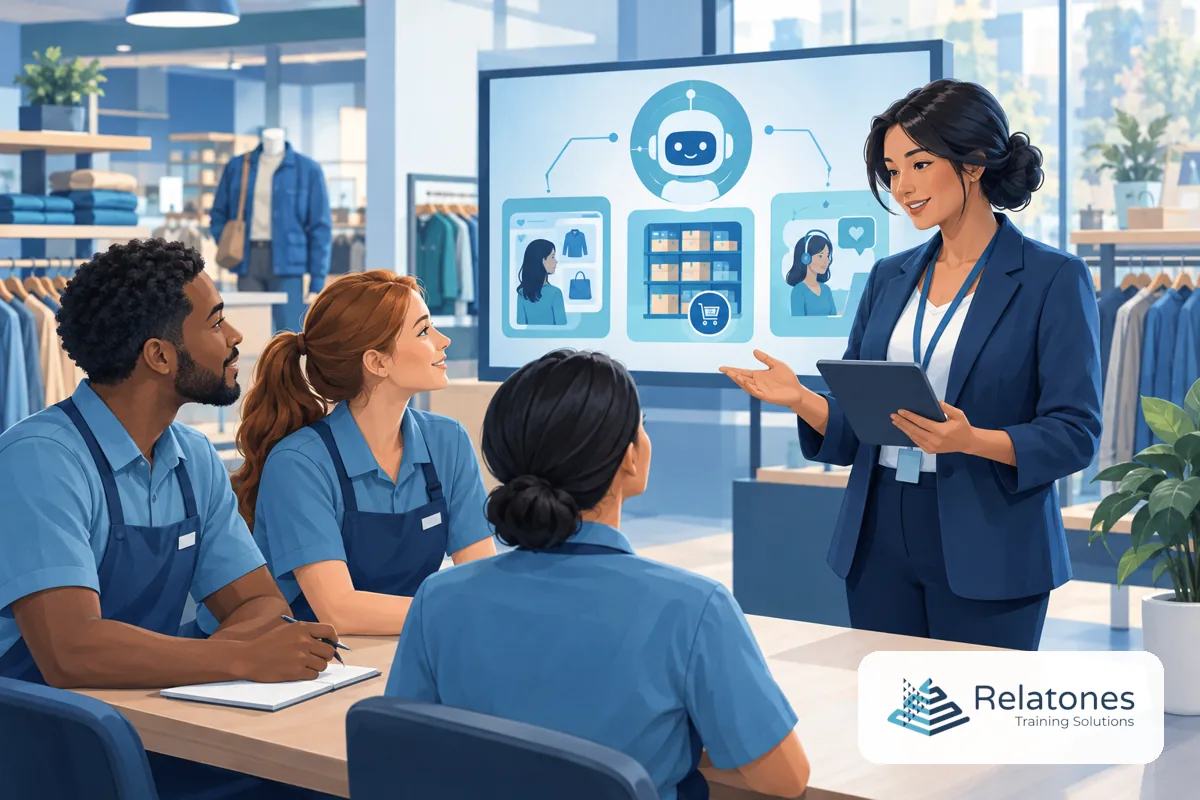
AI training for retail employees is practical instruction that helps store associates, supervisors, and back-office staff use AI tools safely and effectively in their daily workflows. It is not about teaching employees to build AI models. It covers how to prompt AI tools correctly, how to verify outputs, what customer and company data must stay out of public AI services, and when to escalate a decision to a human. For US small and midsize retailers, this kind of training is now an operating need, not a future concern. The gap between teams that use AI tools confidently and teams that use them badly (or not at all) is showing up in service speed, inventory accuracy, and staff retention.
New to this topic? Start with our AI training for employees guide, or explore our AI workforce training program to see how Relatones structures role-based AI enablement for retail teams.
Why AI Training for Retail Employees Matters Now
The adoption curve has moved faster than most training programs. McKinsey’s November 2025 AI survey found 88 percent of companies had adopted at least one AI tool, yet most frontline retail employees have not received structured guidance on how to use those tools correctly. Only 41 percent of retail and consumer-goods employees reported receiving employer-provided AI training in the prior year, compared with 54 percent across industries. The gap is wider for store-level staff: only 33 percent of frontline workers had been trained, versus 52 percent of managers, according to Cognizant research cited in the Perplexity briefing above.
The business case for acting now is straightforward. IBM’s analysis of generative AI in retail found that retail executives estimate more than 41 percent of their workforce will need to reskill as a result of AI and automation over the next three years. That is not a distant forecast. Retailers who wait are already paying for unused software licenses, absorbing errors that come from employees experimenting without guidance, and losing time to manual processes that AI tools could handle in seconds.
The risk side is equally concrete. CISA’s training catalog notes that AI system incidents are costing organizations from $1 million to $15 million or more, with employee behavior (intentional or not) among the primary causes. In retail, the most common exposure points are employees pasting customer loyalty data, payment-related records, or proprietary pricing into consumer AI tools without understanding what happens to that data. Training closes that gap before it becomes an incident.
What AI Training for Retail Employees Should Cover
A focused program does not need to be long. What it needs to be is role-specific and connected to real work. Generic “AI 101” courses rarely change behavior because they do not address the actual screens, workflows, and decisions a store associate or manager faces on a Tuesday afternoon.
A practical program covers these areas:
- AI fundamentals and acceptable use - What AI tools can and cannot do, what hallucinations are, and what your company’s approved-tool list looks like.
- Data privacy and cybersecurity basics - Which categories of information (customer data, payment-related records, employee data, supplier terms) must never enter a public AI tool, and what shadow AI means in a retail context.
- Prompting for retail tasks - How to write clear, task-specific prompts for customer-service responses, product descriptions, inventory summaries, and scheduling communications.
- Output verification - How to check AI-generated text for accuracy, pricing errors, and tone before sending it to a customer or posting it on a channel.
- Bias and fairness basics - How AI tools can reproduce discriminatory outcomes in scheduling, performance assessment, and personalization, and what escalation looks like.
- Human review rules - Which decisions (refunds over a threshold, hiring communications, promotions, pricing changes) require a human sign-off regardless of what the AI suggests.
For a deeper look at responsible AI use in the workplace, see our guide on agentic AI training for business.
How to Build an AI Training Program for Your Retail Team
Starting a program without a clear sequence is the most common mistake. These steps work for a retailer with 50 to 500 employees and no internal L&D function.
-
Choose three to five use cases per role - Start with repetitive, lower-risk tasks: drafting customer responses, generating product-lookup summaries, writing scheduling notes, and summarizing daily sales reports. These deliver visible time savings without requiring employees to make high-stakes autonomous decisions.
-
Write a one-page acceptable-use policy - Before any training begins, document which tools are approved, what data may not be entered, which use cases are permitted, and when human review is required. This takes less than a day to draft and prevents the most common incidents.
-
Assess baseline skills and workflow metrics - Have employees complete two or three representative tasks while you observe. Record how long each task takes and how often errors or escalations occur. You need this baseline to demonstrate ROI later.
-
Build or purchase short, mobile-friendly lessons - For frontline staff, 30- to 60-minute sessions with immediate hands-on practice outperform longer classroom formats. Use sanitized versions of real retail scenarios: a difficult return, an out-of-stock question, a promotional email draft. If your team includes non-English speakers, provide language-matched materials.
-
Appoint one AI champion per store or region - Select an experienced employee or manager, give them protected time to demonstrate approved use cases, maintain a shared prompt library, and collect questions. This peer-level reinforcement replaces the ongoing coaching that an internal L&D team would normally provide.
-
Pilot with one store group before scaling - Run the program with one location for 30 days, collect feedback and early performance data, then adjust before expanding. Scaling a flawed program multiplies the cost of fixing it.
-
Measure behavior and business outcomes, not just completion - Track weekly active use of approved tools, time required for trained workflows, error and escalation rates, and employee confidence at the 30-, 60-, and 90-day marks. Course completion alone does not tell you whether behavior changed.
Skipping the assessment and policy steps is the most consequential shortcut. Without a baseline, you cannot prove ROI. Without a policy, the first time an employee pastes a customer’s loyalty account data into a consumer AI tool, you have an incident with no documented response procedure.
Assess My Team → Free. 10 minutes. No commitment.
A 90-Day Retail AI Training Framework
This framework is designed for a small or multi-location retailer without dedicated L&D staff. It is intentionally lightweight.
| Period | Action | Output |
|---|---|---|
| Days 1-15 | Name an executive sponsor, finalize approved tools, draft acceptable-use policy, choose three to five use cases | One-page policy and pilot charter |
| Days 16-30 | Assess skills and record baseline metrics for two or three workflows | Role-by-role needs map |
| Days 31-45 | Build or purchase short role-based modules; adapt practice scenarios to real retail tasks | Lessons and exercises ready to deploy |
| Days 46-60 | Pilot with one store or region; collect weekly feedback | Early performance data and policy gaps |
| Days 61-90 | Train AI champions, launch reinforcement check-ins, compare results to baseline | Scale or adjust decision with supporting data |
This model works because it proves value at small scale before spending more. The NIH’s research on practice co-evolution in retail found that successful AI integration in retail is an orchestrated, collaborative, multi-stakeholder process. That means managers and employees need to work through the new practices together, not just sit through a one-time seminar.
For high-turnover or seasonal teams, compress Days 31 to 60 into a five- to ten-minute mobile onboarding path that new hires can complete before their first shift, with QR-linked job aids at the register or stockroom.
Delivery Format Options for Retail AI Training
| Format | Best for | Drives behavior change? | Notes |
|---|---|---|---|
| Blended | Multi-location teams with varied schedules | Strong | Combines live instruction with mobile reinforcement; best fit for most SMB retailers |
| Live Virtual | Managers and regional leads who need to discuss policy and edge cases | Strong | Works well for supervisor cohorts; less practical for cashiers and stock associates |
| Live In-Person | Store-level kickoff sessions and AI champion training | Strong | High engagement but requires coverage planning; use for launch, not ongoing delivery |
| Self-Paced | Initial awareness and policy acknowledgment | Limited | Useful for compliance documentation but rarely changes behavior on its own |
Most retailers run blended delivery: a short live session to launch the program and demonstrate approved tools, followed by mobile microlearning that employees complete between tasks, reinforced by an AI champion on the floor.
How Relatones Approaches AI Training for Retail Employees
Relatones starts by mapping your team’s actual workflows before recommending any content. For a retail client, that means identifying which tools are already in use (approved and otherwise), which employee roles have the highest AI exposure, and where the data-privacy risk is greatest. From there, Relatones builds role-specific modules using real retail scenarios, not generic prompting exercises. Managers practice interpreting inventory dashboards and reviewing AI-drafted communications. Associates practice customer-service responses and product lookups with output-verification steps built into every exercise. Champions get a separate track that covers how to reinforce learning on the floor and how to escalate incidents. The result is a team that uses approved AI tools consistently, protects customer data, and can demonstrate measurable time savings in trained workflows within 90 days.
Frequently Asked Questions
Who in a retail business should receive AI training?
Every role that touches an AI tool needs some level of training. Store associates benefit from learning customer-service copilots, product lookup, and translation features. Managers need to understand demand forecasting, scheduling tools, and human-review responsibilities. Owners and administrators should focus on vendor selection, data governance, and return-on-investment measurement. A role-based approach prevents generic training that no one applies.
Who should decide how AI is implemented in a retail business?
Implementation decisions work best when ownership is shared. An executive sponsor sets budget and policy authority. A store-level manager or AI champion handles day-to-day adoption and collects employee questions. Where sensitive customer or employee data is involved, a legal or compliance reviewer should sign off before any tool goes live. Keeping decisions at only one level, either top-down or bottom-up, tends to stall adoption.
What are the most common reasons retail teams delay AI adoption?
The most common reasons are limited technical expertise, uncertainty about which tools to trust, and concern about data privacy. Many owners also worry about training time conflicting with store coverage and about costs that are hard to predict at scale. Starting with one or two practical use cases, a simple one-page acceptable-use policy, and a 90-day pilot keeps the barrier to entry low enough to act.
What barriers make AI training harder for frontline retail workers?
Frontline workers often lack desk time, company email, reliable devices, or language-matched materials. Training scheduled during store hours reduces coverage, while training scheduled outside hours raises wage and overtime questions. Short, mobile-friendly lessons in multiple languages, delivered through tools employees already use, remove most of these barriers without requiring a dedicated learning management system.
What tasks do retail employees currently use AI for most?
The most practical current uses are drafting customer-service responses, looking up product information or promotions, summarizing inventory or sales reports, and generating scheduling communications. Managers also use AI to create coaching notes and performance summaries. These repetitive, lower-risk tasks are the right starting point because they deliver visible time savings without requiring employees to make high-stakes autonomous decisions.
Start Before Your Competition Does
Retail teams that invest in structured AI training now are compressing the same workflows that currently take hours into minutes, while teams without training are either avoiding the tools entirely or using them in ways that create data and accuracy risks. The 90-day framework above is designed to fit a retailer with no internal L&D team, a limited budget, and a floor that cannot go dark for a training day. The first step is understanding where your team actually stands.
Assess My Team → Free. 10 minutes. No commitment.
Sources & References
Every statistic in this article is drawn from primary, US-based research. Explore the original sources below.