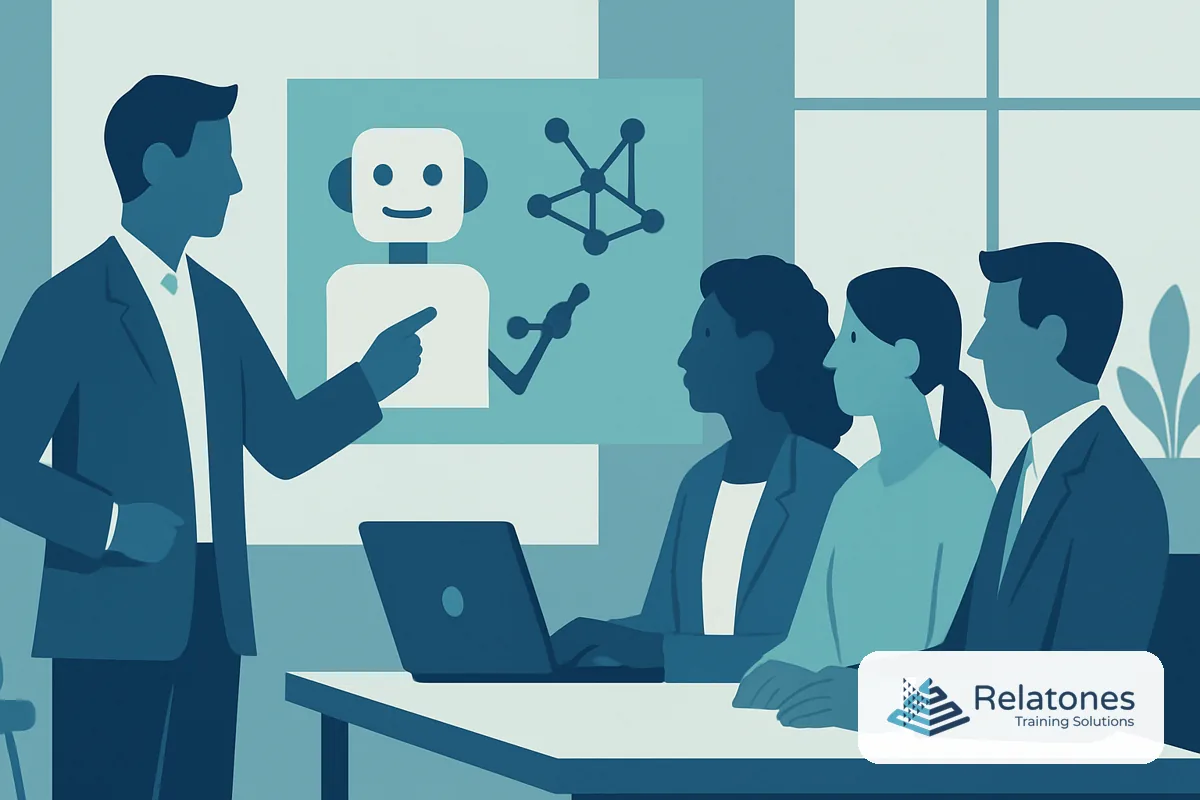
AI tools training for HR teams is structured learning that teaches HR staff how to use generative AI and automation tools safely and effectively inside real HR workflows—recruiting, onboarding, performance management, policy drafting, and employee support. It matters now because AI adoption has outpaced HR-specific skills at exactly the moment when the legal stakes for misuse are rising. This post covers what the training must include, a step-by-step rollout process, and how to do it without an internal L&D function. If your team is already juggling tools they don’t fully trust, you’re not alone—and the path forward is more manageable than it looks.
New to this topic? Start with our complete AI training guide, or book a free demo to see how a role-specific session runs.
Why AI Tools Training for HR Teams Matters Now
HR adoption of AI is accelerating fast. According to SHRM’s 2026 State of AI in HR report, the share of organizations actively using AI in HR functions jumped from 26% in 2024 to 43% in 2025—and that number is still climbing. The tools are arriving faster than the skills to use them well.
The gap between access and capability is the real problem. The U.S. Chamber of Commerce reports that only 14% of small businesses are fully integrating AI into core operations, and over 70% of small business owners say they would benefit from more AI training. Meanwhile, AIHR puts it plainly: the bottleneck is not a lack of tools—it is knowing where and how to use them inside HR workflows. For a two- or three-person HR team managing 200 employees, that gap creates daily friction and growing legal exposure.
The cost of inaction is both operational and legal. Generative AI used well can save up to 70% of HR’s time on administrative tasks, according to AIHR’s 2026 research. Companies that delay AI adoption or fail to train HR staff continue to carry that administrative burden while competitors move faster. But there is a harder risk: HR functions touch hiring, promotion, and performance management—domains where algorithmic bias and data mishandling can trigger EEOC claims, California CCPA violations, and emerging state AI statutes. One discrimination claim or regulatory investigation can cost far more than a well-designed training program.
What AI Tools Training for HR Teams Should Cover
Generic “10 prompts to try” content does not cut it for HR. The real conversation is about leading people through change responsibly—and that requires coverage of both skills and governance. Here are the five areas every program must address:
- AI literacy specific to HR - What modern HR AI tools can and cannot do, with honest coverage of hallucinations, overconfidence, and the cases where human judgment must stay final.
- Prompting and workflow design - How to write effective, repeatable prompts for HR tasks: job descriptions, interview guides, policy drafts, onboarding FAQs, and performance-review summaries.
- Output validation and bias awareness - How to audit AI-generated shortlists, review job language for exclusionary wording, and document human oversight of every AI-influenced decision.
- Responsible and compliant use - Which HR data can and cannot be fed into which tools, how CCPA applies to employee data in California, and what emerging state AI laws—including Colorado’s AI Act and NYC Local Law 144—require of employers using automated employment decision tools.
- Role-specific HR applications - Where AI genuinely creates value by function (talent acquisition, HRBP, HR Ops, people analytics) and where it should not be used without explicit human review.
For a broader look at building AI literacy across the whole organization, see our complete AI training guide for employees.
How to Roll Out AI Tools Training for HR Teams (Step by Step)
Start small, build fast, and produce usable artifacts at every stage. Teams that try to train on everything at once produce awareness, not capability.
- Run a skills audit first - Survey each HR role to map current AI proficiency and identify which workflows are already using AI tools, even informally. A 10-question self-assessment takes under an hour and shapes everything that follows.
- Define outcomes tied to HR metrics - Tie training goals to measurable HR results: faster time-to-fill, fewer policy escalations, more consistent performance documentation, reduced time drafting job postings. Vague goals produce vague results.
- Build role-specific tracks - Talent acquisition, HRBPs, HR Ops, and people analytics staff use AI differently. A unified one-size-fits-all session wastes time and loses people. Differentiate by how much each role interacts with AI day-to-day.
- Run five live, HR-specific sessions with deliverables - Cover recruiting AI, performance management AI, employee monitoring tools, vendor due diligence, and transparent employee communication—one session each, 60–90 minutes, spaced over four to six weeks. Require a written output from each session: a bias-audit template, an oversight checklist, a vendor question set, an employee FAQ. Training time becomes governance infrastructure.
- Add tool-specific practice on your actual stack - Work with your ATS, HRIS, and performance platform vendors to run live, tool-specific sessions on features your team already has access to. This is where skills become habits.
- Track adoption and iterate - Measure time saved per HRBP per week, number of AI-assisted workflows in regular use, and error or escalation rates. Review monthly and update content as tools and regulations evolve.
Skipping the skills audit and role differentiation (steps 1 and 3) produces generic training that HR teams sit through and then ignore. Skipping the deliverables (step 4) means nothing sticks past the end of the session.
Assess My Team → Free. 10 minutes. No commitment.
The HR AI Governance Checklist
Before any AI tool goes live in an HR workflow, run through this checklist. It takes 20 minutes and can prevent months of remediation.
- Data inputs - Does the tool process employee demographics, health data, biometrics, or performance history? If yes, confirm your privacy and data handling obligations under CCPA, HIPAA, or applicable state law before use.
- Bias testing - Has the vendor provided documentation of bias testing methodology and results? Use SHRM’s vendor question checklist as your baseline.
- Explainability - Can the tool explain why it surfaced a candidate, flagged a performance issue, or recommended an action? If not, human override must be mandatory before any decision is communicated.
- Decision authority - Is the tool configured as decision support (flags, summaries, recommendations) or is it making final decisions? Final decisions on hiring, promotion, discipline, and termination must remain with a human, and that review must be documented.
- Employee notice - Do employees and applicants know AI is being used in HR processes that affect them? California and several other states require disclosure. Draft that communication before rollout, not after a complaint.
- Update cadence - AI regulations are a patchwork that is getting denser fast. Deloitte’s 2026 HR tech predictions flag governance and trust as the defining HR technology themes of the year. Build a quarterly review of your AI governance posture into the HR calendar.
Expert-led training beats DIY here because an outside facilitator can challenge your team’s assumptions about what your vendors actually deliver versus what the marketing materials say.
Delivery Format Comparison
| Format | Best for | Drives behavior change? | Notes |
|---|---|---|---|
| Blended | Teams with mixed AI proficiency levels | Strong | Live sessions for governance and bias topics; microlearning for tool skills. Best overall fit for HR teams. |
| Live Virtual | Distributed HR teams or multi-location SMBs | Strong | Keeps discussion and Q&A intact. Works well for the five-session governance curriculum. |
| Live In-Person | Tight-knit HR teams under 10 people | Strong | Highest engagement for sensitive topics like bias and employee transparency. |
| Self-Paced | Foundational AI literacy baseline only | Limited | Acceptable for pre-work before live sessions. Not sufficient alone for behavior change in governance or bias topics. |
How Relatones Approaches AI Tools Training for HR Teams
Relatones starts with a role-by-role assessment of how your HR team currently interacts with AI tools—what they’re using, what they’re avoiding, and where the governance gaps are. From there, we build sessions around your actual HR tech stack and the specific workflows your team runs every day: recruiting, onboarding, performance cycles, policy management. Every session ends with a usable artifact—a bias-audit template, a vendor checklist, an employee FAQ—so training time produces governance infrastructure, not just awareness. We weave US compliance context (CCPA, EEOC obligations, and applicable state AI statutes) into every module rather than treating it as a separate compliance add-on. The outcome is an HR team that uses AI with confidence, documents its oversight, and can defend every AI-influenced decision—a team that is measurably faster and significantly less exposed.
Frequently Asked Questions
How do we lead HR teams through AI adoption responsibly, not just hand them a prompt list?
Responsible adoption means pairing tool skills with governance: bias awareness, data handling rules, and a clear policy on where human judgment must stay final. Structure training across five HR-specific sessions—recruiting AI, performance AI, monitoring tools, vendor due diligence, and employee communication—each ending with a usable artifact like a checklist or policy draft. That turns learning time into infrastructure, not just awareness.
How do I spot fake or AI-generated candidate profiles in recruiting?
Train your TA team to look for tell-tale signals: overly polished language with no specificity, employment dates that don’t align with verifiable company histories, and headshots that fail a reverse-image search or show AI artifacts around hair and background edges. Pair that with structured phone screens that ask for concrete, unprompted details about past work. Most AI-generated profiles collapse under a single follow-up question.
How can AI tools cut time-to-hire without adding compliance risk?
AI shortlists, interview-scheduling automation, and AI-drafted job descriptions can compress time-to-hire significantly, but only when HR staff know how to audit outputs for bias before acting on them. That means checking shortlists against demographic benchmarks, reviewing AI-generated job language for exclusionary wording, and documenting every AI-assisted decision. Speed without that audit layer is where discrimination liability enters.
How do I reduce HR workload safely with AI?
Start with low-stakes, high-volume tasks: drafting job descriptions, generating onboarding FAQs, summarizing pulse-survey results, and formatting performance-review templates. These are areas where an error is easy to catch and correct before it affects anyone. Reserve final decisions on hiring, promotion, discipline, and termination for human review every time, and document that review so you have a clear audit trail.
What happens when AI agents become part of the workforce?
AI agents—autonomous systems that can initiate tasks, send messages, update records, and make scheduling decisions without a human prompt—are already embedded in several HR platforms. HR teams need training on how to define the boundaries of agent authority, how to review agent-generated actions before they affect employees, and how to communicate transparently to staff about which interactions are human versus automated. Governance frameworks like the NIST AI RMF provide a starting structure.
Your HR Team Deserves More Than a Prompt List
AI tools training for HR teams is not a tech initiative—it is a governance and people responsibility. The HR functions that move forward without it face rising legal exposure, underutilized tools, and the kind of inconsistency that creates fairness complaints. The ones that invest in structured, role-specific training build faster processes, stronger documentation, and teams that employees and candidates actually trust. Start with a 10-minute assessment of where your gaps are.
Assess My Team → Free. 10 minutes. No commitment.
Sources & References
Every statistic in this article is drawn from primary, US-based research. Explore the original sources below.
- 1State of AI in HR 2026: Full Report
- 22025 Talent Trends: AI in HR
- 3AI Training Guide for Small Business
- 4AI for HR Teams
- 5Must-Ask Questions for AI Tools Vendors in HR
- 62026 HR Tech Predictions: Governance and Trust Guide HR Technology Decisions
- 7Best AI Tools for HR Teams 2026
- 8AI Training for Employees: The Complete 2026 Guide