
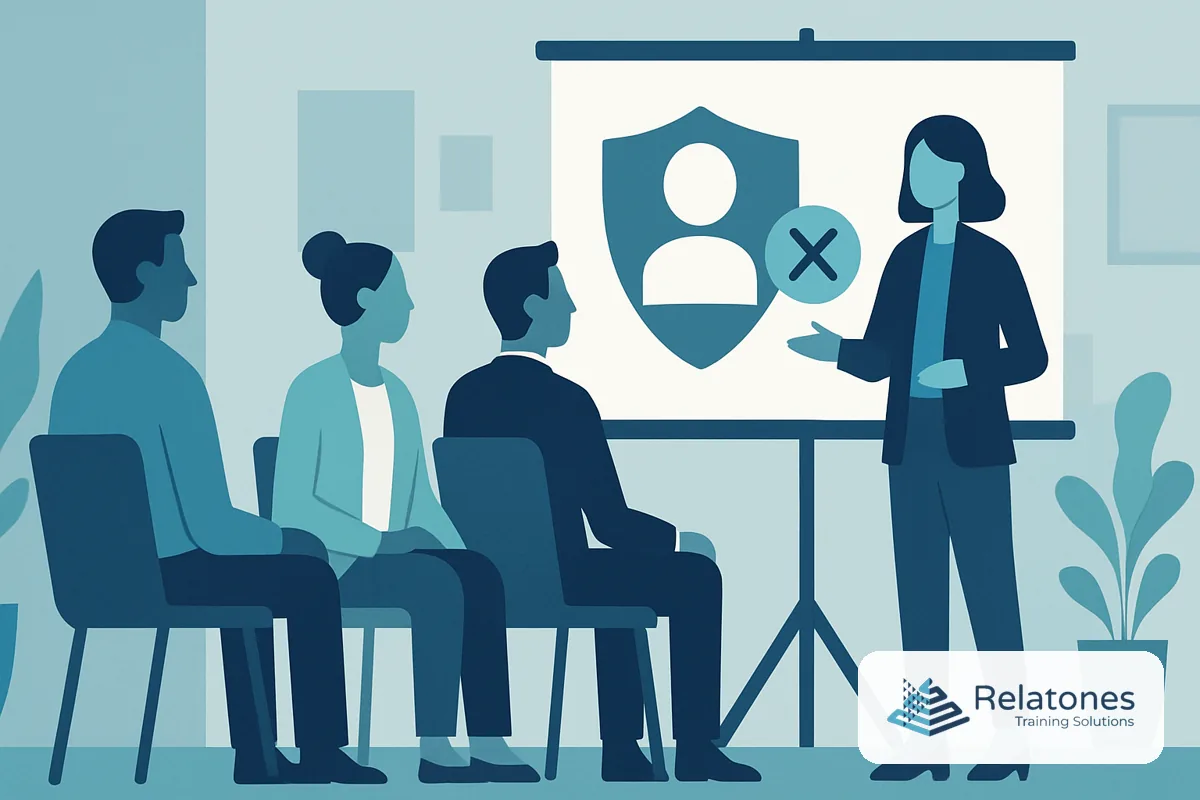
Anti-harassment training for employees is workplace instruction that teaches people how to recognize, prevent, report, and respond to harassment—with separate requirements for supervisors in many state laws and federal agency guidelines. For US SMBs with 50–500 employees, this training is not a large-company concern: federal Title VII protections apply at 15 employees, and multiple states set the bar even lower. This post covers exactly who must train, what the training must include, how to implement it without an internal L&D team, and how to document everything so it holds up in court. The honest challenge most HR leads face is that definitions of harassment vary wildly between employees—“I didn’t think repeatedly asking someone out was harassment” is a real thing people say—and that gap in understanding is where liability lives.
New to compliance training? Start with our complete employee compliance training guide, or explore how Relatones runs harassment prevention sessions built for US SMBs.
Why Anti-Harassment Training Matters Now
The legal floor keeps rising. California requires sexual harassment prevention training for employers with five or more employees, and New York State requires annual training for every employer with at least one employee. Eight states now have sexual harassment training statutes—California, Connecticut, Delaware, Illinois, Maine, New York, Washington, and the District of Columbia—plus city-level rules in Chicago and New York City. If your company has employees in more than one of these jurisdictions and applies a one-size-fits-all approach, you are almost certainly out of compliance somewhere.
The cost of doing nothing goes well beyond fines. Harassment claims expose employers to legal fees, settlements, and damages that can be substantial even when the employer ultimately prevails. Worse, employers who cannot prove they trained all employees may lose the ability to assert an affirmative defense or avoid punitive damages in litigation. That is not a theoretical risk—it is the mechanism the EEOC uses to evaluate employer conduct when a complaint is filed.
The upside is real and quantifiable. The EEOC emphasizes that interactive, skills-based training—covering bystander intervention, reporting options, and acceptable conduct—is more effective at creating cultural change than passive, checkbox-style compliance courses. Companies that do this well reduce attrition driven by hostile work environments, lower insurance exposure, and build the documentation record that protects them if a complaint ever escalates.
What Anti-Harassment Training Should Cover
Strong anti-harassment training goes beyond legal definitions. The EEOC’s current guidance makes clear that the goal is behavior change—not just awareness—and that separate content for supervisors and employees is essential because their obligations differ significantly.
A compliant, effective program covers:
- Recognition - What harassment looks like in practice, including verbal, physical, visual, and digital forms (chat, email, video calls, social media). Many employees genuinely do not recognize that persistently asking a colleague out after repeated rejections meets the legal definition.
- Bystander intervention - How employees can safely support a colleague, interrupt inappropriate behavior, or report what they witnessed. Research cited by SHRM-linked vendors shows bystander-focused training drives more lasting cultural change than compliance-only content.
- Reporting channels and process - Step-by-step instructions for how to report, to whom, and through what channels. Employees need at least two options so they are never forced to report to the person harassing them.
- Anti-retaliation protections - Explicit coverage of what retaliation looks like, that it is prohibited, and that it is itself a policy violation. Employees who do not believe retaliation protection is real will not report—full stop.
- Manager-specific obligations - Supervisors have a legal duty to act when they observe or learn of potential harassment, even without a formal complaint. This requires its own module and its own time allocation.
- Remote and hybrid scenarios - Harassment via Slack, Teams, Zoom, or direct messages is workplace harassment. Training that ignores digital channels misses where a significant share of modern misconduct occurs.
For a broader look at how harassment prevention fits into your overall compliance program, see our complete employee compliance training guide.
How to Implement Anti-Harassment Training Step by Step
Most US SMBs without an internal L&D function try to handle this with off-the-shelf courses they never customize, or they assign training once and consider it done. Neither approach holds up legally or culturally.
- Map your legal requirements by state - List every state where you have employees and confirm the specific training requirements: who must train, how long, how often, and what topics are mandatory. California requires two hours for supervisors and one hour for other employees every two years, with new hires trained within six months. New York State requires annual training for all employees. Default to the strictest standard across your workforce to simplify administration.
- Finalize a written anti-harassment policy - Distribute a clear policy that defines prohibited conduct, names at least two reporting contacts, states the anti-retaliation commitment, and describes how investigations are handled. Require employees to acknowledge it at hire and at least annually. Without a documented policy, even good training provides limited legal protection.
- Select an external training vendor with state-compliant content - Look for separate modules for managers and employees, scenario-based interactivity, and a current compliance statement covering every state where you operate. Vendors such as NAVEX provide US-legislation-aligned courses with built-in completion tracking. Ask for a 2026 compliance statement and a list of covered jurisdictions before signing.
- Train managers first - Roll out the manager module in the first 30–60 days. Pair it with a live virtual session led by an external facilitator so supervisors can practice responding to complaints and handling retaliation questions in real time. Manager-specific training matters because supervisors who mishandle a report can create secondary liability.
- Roll out to all employees within 90 days - Assign the employee course with a clear completion deadline (two to four weeks is reasonable). Track completions in real time and follow up on non-completions before the window closes.
- Document everything - Store completion records by employee name, course title, version, and date. Keep copies of the policy in effect each year and records of annual acknowledgments. Maintain investigation records separately and confidentially. Documentation is what transforms training from a culture initiative into a legal defense.
- Reinforce between cycles - Add a brief behavioral expectations reminder to onboarding, all-hands meetings, and new manager orientations. Run an anonymous pulse survey annually to check whether employees know how to report, feel comfortable doing so, and trust that complaints are taken seriously.
Skipping the documentation step is the single most common mistake. An employer who trained everyone but cannot prove it is legally in the same position as one who never trained at all.
Assess My Team → Free. 10 minutes. No commitment.
The Anti-Harassment Training Compliance Checklist
Use this before your next training cycle. If you cannot answer “yes” to each item, that gap is your legal exposure.
- Written policy in place - Covers in-person and digital harassment, includes at least two reporting contacts, and states that retaliation is prohibited and actionable
- Annual acknowledgment on file - Every employee signs or electronically confirms the current policy version at hire and at least once per year
- State requirements mapped - You know what each state where you have employees requires: audience, duration, frequency, and mandatory topics
- Separate manager module assigned - Supervisors receive dedicated content on duty to report, complaint handling, and retaliation prevention—not just the employee course
- Scenario-based, interactive content used - Training includes real-world situations, branching decisions, and skills practice, not just definitions and legal text
- New hire training scheduled within required timeframe - California: within six months of hire or promotion; New York: within 30 days; temporary/seasonal staff in California: within 30 days or 100 hours, whichever comes first
- Completion records exportable - Your vendor or LMS can produce a report by employee name, course, version, and completion date for any audit or legal proceeding
- Retraining scheduled - All employees retrain at least every two years; annual retraining in New York
Expert-led training outperforms self-built or unmoderated DIY courses because facilitators correct misconceptions in real time—the kind of misconception where someone genuinely believes asking a colleague out eight times is not harassment until a trainer explains otherwise.
Training Format Comparison
| Format | Best for | Drives behavior change? | Notes |
|---|---|---|---|
| Blended | Teams with mixed roles and locations; manager + employee split | Strong | Combines self-paced e-learning for baseline knowledge with live virtual practice for managers; most defensible format for compliance |
| Live Virtual | Manager cohorts; organizations needing Q&A and scenario practice | Strong | Enables real-time correction of misconceptions; ideal for supervisor-specific obligations and complaint-handling practice |
| Live In-Person | Leadership teams; post-incident culture rebuilding | Strong | Highest engagement; best for shifting deeply embedded attitudes; less practical for large or distributed workforces |
| Self-Paced | Baseline employee awareness; documentation of completion | Limited | Meets legal minimums in most states; does not drive the behavior change that reduces actual incidents; use as a foundation, not a complete program |
How to Choose an Anti-Harassment Training Provider
When selecting a provider, look for programs that go beyond policy recitation. The most defensible training — and the training that actually changes behavior — uses scenario-based content tailored to your industry and workforce. Separate tracks for managers and employees matter: supervisors have different obligations (complaint handling, documentation, investigation duties) than frontline staff. Look for programs that cover bystander intervention and digital-harassment scenarios that match how your team actually communicates. Documentation is non-negotiable: every participant should receive a dated completion certificate with content summary, formatted for the regulator who might request it. Programs that only provide a generic PDF may not satisfy a DFEH or EEOC review. The outcome you are looking for is a team that can recognize harassment, knows exactly how to report it, and trusts that doing so is safe — which is what actually reduces incidents and liability over time.
Frequently Asked Questions
Which US employers are legally required to provide anti-harassment training for employees?
Federal Title VII protections apply to employers with 15 or more employees, but several states go further. California requires training for employers with five or more employees, and New York State requires annual training for employers with even one employee. Employers with staff in California, New York, Connecticut, Illinois, Delaware, Maine, or Washington should check the specific requirements for each state where employees work, not just where the company is headquartered.
How often does anti-harassment training need to happen?
It depends on the state. California requires training every two years, with new hires and newly promoted supervisors trained within six months of starting the role. New York State requires training every year. Even in states with no mandatory cadence, the EEOC recommends ongoing training—not a one-time event—as part of a defensible harassment prevention program.
What does your policy say about retaliation, and do employees actually believe it?
Your written policy should explicitly state that retaliation against anyone who reports in good faith or participates in an investigation is prohibited and is itself a policy violation. But the policy only matters if employees trust it. Training should reinforce the anti-retaliation commitment with real scenarios, and leadership must visibly model that reporting is safe. Anonymous pulse surveys are a low-cost way to check whether employees actually believe the policy.
Could we have an underreporting problem without realizing it?
Yes—and it is more common than most managers expect. When harassment goes unreported, it usually means employees do not trust the reporting process, fear retaliation, or simply do not recognize certain behaviors as harassment. Persistently asking a colleague out after repeated rejections is harassment under federal and state law, but many employees do not identify it that way. Effective training corrects those misunderstandings before an incident escalates into a complaint.
How do you know if someone is uncomfortable with your behavior?
Training should answer this directly. Discomfort is not always verbal—people may go quiet, avoid eye contact, change the subject, or physically withdraw. The legal standard under Title VII is whether conduct is unwelcome, not whether the other person said “stop.” Scenario-based training is the most effective way to help employees recognize these signals and adjust behavior before harm occurs.
The Cost of Waiting Is Higher Than the Cost of Training
Every month without documented, state-compliant anti-harassment training for employees is a month your company cannot assert the affirmative defenses that reduce or eliminate punitive damages in a harassment claim. The training itself is manageable—the legal exposure without it is not. Map your state requirements, assign role-specific content, and document every completion.
Assess My Team → Free. 10 minutes. No commitment.
Sources & References
Every statistic in this article is drawn from primary, US-based research. Explore the original sources below.
- 1Harassment Prevention and Respectful Workplaces Training
- 2Sexual Harassment Training Requirements by State
- 3Think Your Small Business Is Exempt from Harassment Liability? Think Again.
- 4Is My Business Required to Provide Harassment Training?
- 5Sexual and Other Workplace Harassment Training
- 6Workplace Harassment Training Courses
- 7Workplace Harassment and the Law
- 8Sexual Harassment Training Vendor Directory