
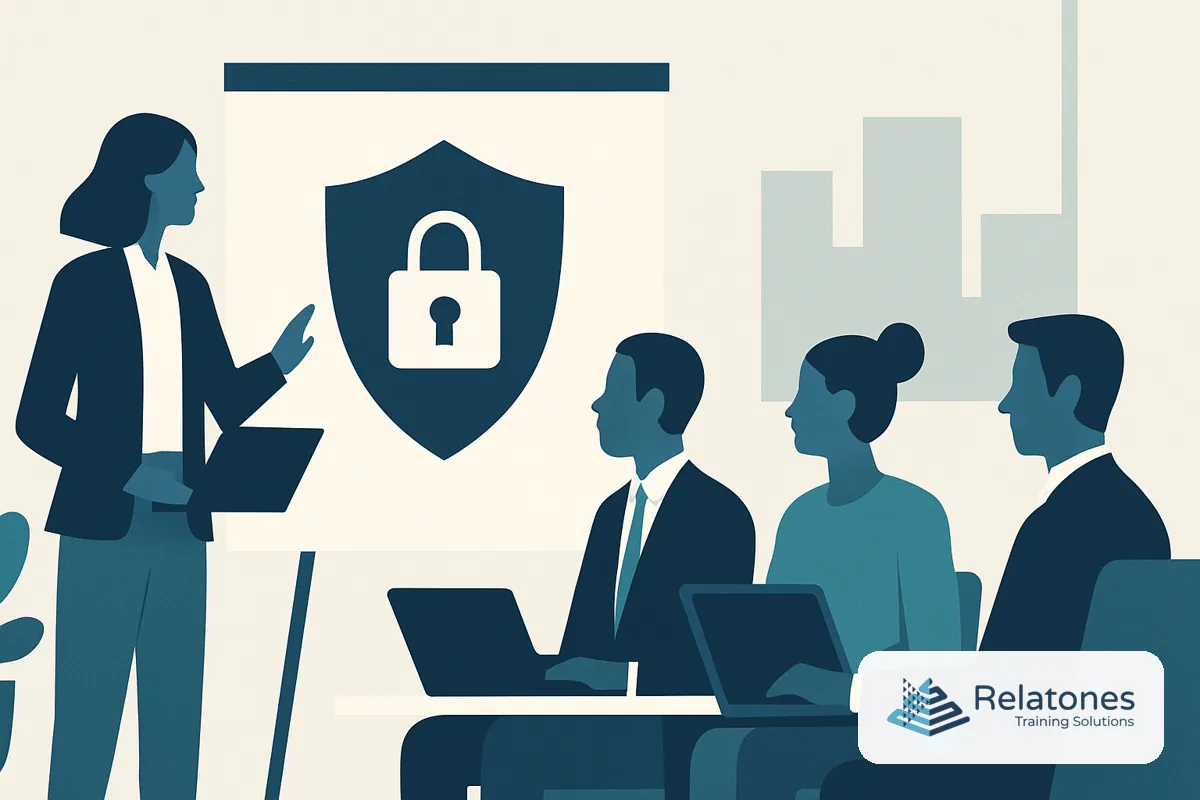
A cyber hygiene training program is a structured, ongoing employee education effort that teaches the everyday security habits—spotting phishing, managing passwords, enabling MFA, updating software, and reporting incidents—that prevent the majority of cyberattacks. For US companies with 50–500 employees and no dedicated security team, it is usually the highest-impact, lowest-cost defense available. Yet most programs fail not because the content is wrong, but because they treat security education as a one-time compliance event rather than a habit-building system. If your team dreads the annual “click through the slides” training, this guide replaces that approach with something that actually works.
New to this topic? Start with our complete cybersecurity awareness training guide, or book a free demo to see how a program built for your team actually runs.
Why a Cyber Hygiene Training Program Matters Now
The numbers make the case bluntly. According to the 2025 Verizon Data Breach Investigations Report, 60% of confirmed breaches involve the human element, and phishing remains the number-one initial access vector. Credential abuse accounts for 22% of initial access, and vulnerability exploitation—often enabled by unpatched employee devices—accounts for another 20%, per the same report. These are not sophisticated nation-state attacks. They are preventable mistakes.
The cost of a single breach puts the training investment in sharp relief. IBM’s 2024 data placed the average US breach cost at $4.88 million—and 2025 estimates push that figure higher when regulatory fines and detection costs are included. By contrast, industry benchmarks put security awareness training at roughly $100–$200 per employee per year. A 100-person company might spend $15,000 annually on a managed program. That is a rounding error compared to a single incident.
The regulatory pressure is real too. The FTC Safeguards Rule requires covered financial firms to include security awareness training in their written information security programs. HIPAA mandates workforce training for all covered entities and business associates. State regulators across California and beyond increasingly treat documented, ongoing training as the benchmark for “reasonable security.” If a breach occurs and you cannot show evidence of a training program, the compliance exposure compounds the incident cost.
What a Cyber Hygiene Training Program Should Cover
The strongest programs focus on a short list of high-frequency, high-impact behaviors—not an exhaustive policy dump. As one administrator put it, “It’s the laundry list of behaviors that’s listed in all of our policies—the regulation, what are we trying to comply with?” The answer should be practical, not encyclopedic.
CISA’s SMB guidance and the DoD’s Be Cyber Smart resources both converge on the same core behaviors:
- Phishing recognition—Teach employees to verify sender addresses, hover over links before clicking, question unexpected requests for credentials or wire transfers, and report anything suspicious rather than delete it quietly.
- Strong, unique passwords—Cover why password reuse is dangerous and how a password manager eliminates the memory burden. One compromised password should not unlock every account.
- Multi-factor authentication (MFA)—MFA on email, VPN, and business apps is the single fastest way to neutralize stolen credentials. Training should cover both why it matters and how to set it up.
- Software and device updates—Attackers exploit known vulnerabilities in unpatched systems. Employees need to understand why “remind me later” is a security decision, not just an inconvenience.
- Remote work and device hygiene—Screen locks, encrypted drives, secure Wi-Fi, and VPN use are daily habits for any team with remote or hybrid workers.
- Incident reporting—Employees who know exactly who to call and what to say when something looks wrong are your fastest early-warning system. Remove the fear of being blamed for clicking.
For role-specific depth, see our complete cybersecurity awareness training guide for how to tier content by risk level.
How to Build a Cyber Hygiene Training Program Step by Step
Running a one-time annual training and calling it a program is the most common mistake mid-sized US companies make. Here is a model that works without an internal L&D team.
-
Run a baseline assessment — Before you design a single module, identify your riskiest behaviors and departments. Send a controlled phishing simulation. Survey employees on password habits. Review your incident log. The NIST small business training resource and the Cyber Readiness Institute’s free SMB program both provide structured starting points. You need data before you need content.
-
Define role-based training tracks — Finance, HR, executives, and IT/admin users face different threats at different frequencies. A wire-transfer-processing accountant needs deep business email compromise (BEC) training. A warehouse supervisor needs clear device hygiene habits. Map the tracks before you build them.
-
Deliver an onboarding module for every new hire — Security habits form early. Every new employee should complete a short, practical cyber hygiene module before they access company systems—not at the 90-day review. Tie completion to system access provisioning so it cannot be skipped.
-
Run monthly microlearning on one behavior at a time — One topic per month, five to ten minutes per session. Phishing in October, MFA in November, password managers in December. Bite-sized repetition builds habits far more reliably than an annual two-hour marathon.
-
Simulate phishing quarterly and coach immediately — Quarterly phishing simulations with instant, non-punitive coaching for anyone who clicks are the most effective behavior-change mechanism in security awareness. The coaching moment matters as much as the simulation. Track click rates and report rates by department, and watch both improve over time.
-
Require annual policy attestation tied to HR or access workflows — Every employee should sign off annually that they have read and understood the core security policy—password requirements, acceptable use, remote work rules, and incident reporting. Tie it to access renewal or performance review so it has teeth.
Skip steps one and two, and you train people on the wrong things. Skip step five, and you have completion rates but no behavior change.
Assess My Team → Free. 10 minutes. No commitment.
The SMB Cyber Hygiene Training Scorecard
Use this quick framework to evaluate your current program before you invest in changes. Score each area: 2 points if fully in place, 1 if partial, 0 if missing.
- Baseline assessment completed — Do you know which teams and behaviors are highest risk right now?
- Role-based content — Are finance, HR, and executives trained on the threats specific to their roles?
- Onboarding module — Does every new hire complete training before system access is granted?
- Monthly microlearning cadence — Is something happening every month, or only at annual review time?
- Phishing simulations running — Are you testing and measuring, or just training and assuming?
- Incident reporting pathway — Does every employee know exactly how to report a suspicious email or device?
- Documented completion records — Can you produce compliance evidence in 24 hours if a regulator or insurer asks?
A score of 10–14 means your program is solid. A score under 8 means you have meaningful exposure—and the gap between where you are and where you need to be is almost always a delivery and cadence problem, not a content problem. Expert-led, managed delivery closes that gap faster than any DIY curriculum project, because the vendor handles content updates, simulation campaigns, and reporting dashboards so your internal team does not have to.
Training Delivery Format Comparison
| Format | Best for | Drives behavior change? | Notes |
|---|---|---|---|
| Blended | Teams of 50–500 with mixed remote/in-person roles | Strong | Combines live instruction with async microlearning; best for building lasting habits across departments |
| Live Virtual | Remote-first teams; role-specific deep dives (finance, exec) | Strong | High engagement when sessions are short (30–45 min) and scenario-based; easy to record for onboarding |
| Live In-Person | Leadership cohorts; high-risk departments needing hands-on practice | Strong | Ideal for tabletop exercises and incident-response walkthroughs; harder to scale across 200+ employees |
| Self-Paced Only | Annual policy attestation; new-hire baseline reading | Limited | Completion rates look good; behavior change rates do not—do not rely on this format alone for cybersecurity |
How Relatones Approaches Cyber Hygiene Training
Relatones starts every engagement with a behavioral assessment—not a content catalog. We identify which departments are clicking phishing links, where password reuse is highest, and whether employees actually know how to report an incident. From that data, we build role-based training tracks that match threat profiles, not org charts. Delivery combines short live virtual sessions with monthly microlearning pushed directly to employees, so habits form continuously rather than once a year. Phishing simulations run quarterly, with immediate coaching built into the workflow—so the moment of failure becomes the moment of learning. We track click rates, report rates, and behavior improvement by department, and we give your leadership team a plain-English dashboard to show auditors, insurers, and executives. The result is a team that recognizes threats faster, reports them consistently, and gives your organization documented evidence of a functioning program.
Frequently Asked Questions
How do you train employees on cyber hygiene in the workplace?
Start with a baseline assessment to find your riskiest behaviors and departments. Then deliver role-based modules on phishing, passwords, MFA, software updates, and incident reporting. Layer in monthly microlearning and quarterly phishing simulations to reinforce habits over time. Track click rates, report rates, and completion—not just attendance.
What should a cyber hygiene training program cover?
A strong program covers phishing recognition, strong and unique passwords, multi-factor authentication, timely software updates, safe remote-work practices, and a clear incident-reporting process. Role-based modules for high-risk groups—finance, HR, executives—add meaningful depth beyond the baseline. The goal is repeatable daily habits, not a one-time compliance checkbox.
How often should employees complete cyber hygiene training?
At minimum, run a full refresher quarterly alongside monthly microlearning on a single behavior. Phishing simulations should run at least quarterly as well, with just-in-time coaching delivered immediately after a failed click. New hires need an onboarding module before they access company systems, and all staff should sign an annual policy attestation tied to access or HR workflows.
Does a cyber hygiene training program protect against ransomware?
Yes—significantly. Ransomware typically enters through phishing emails or stolen credentials, both of which a well-run training program directly targets. Teaching employees to recognize suspicious links, use unique passwords with a password manager, and enable MFA removes the most common entry points attackers rely on. Training alone is not a complete defense, but it eliminates the easiest paths in.
Is cyber hygiene training required by US regulations?
Several US frameworks mandate or strongly imply it. The FTC Safeguards Rule requires security awareness training as part of a written information security program for covered financial firms. HIPAA requires workforce training on security awareness, including phishing and password management, for all covered entities and business associates. State regulators increasingly treat documented employee training as evidence of “reasonable security” when a breach occurs.
The Gap Between Completing Training and Changing Behavior Is Fixable
Sixty percent of breaches still involve human error—not because employees are careless, but because most training programs are designed to check a compliance box, not build a habit. A well-structured cyber hygiene training program, run continuously with real simulations and role-based content, closes that gap. The cost of building it is a fraction of the cost of a single incident. Start by understanding where your team actually stands.
Assess My Team → Free. 10 minutes. No commitment.
Sources & References
Every statistic in this article is drawn from primary, US-based research. Explore the original sources below.