
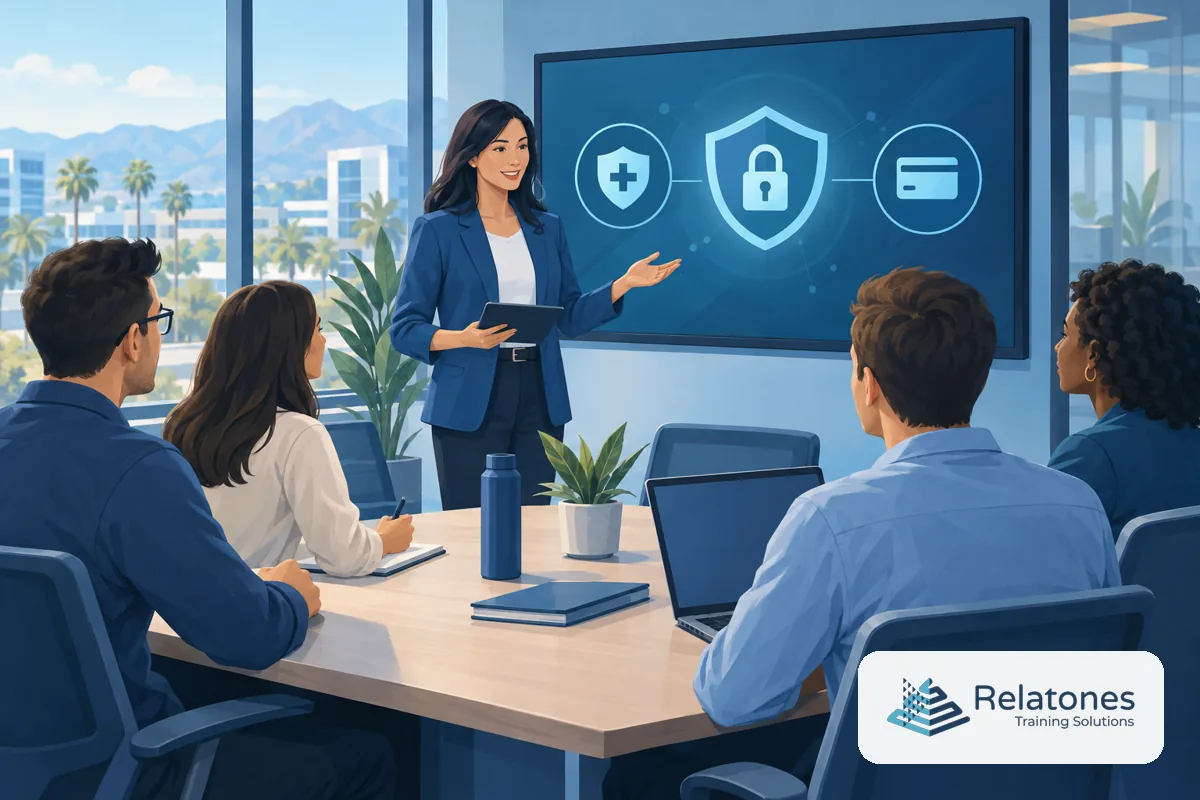
Cybersecurity training in Irvine is structured employee education that teaches staff at local businesses how to recognize and respond to cyber threats, and how to handle sensitive data in ways that satisfy regulators and auditors. For Orange County companies carrying SOC 2, HIPAA, or PCI DSS obligations, this kind of cybersecurity training Irvine businesses rely on is not optional: each framework requires documented, recurring instruction as a condition of compliance. The challenge most Irvine SMBs face is not awareness of the need, but building a program that actually changes behavior, survives an audit, and fits within a limited IT budget.
New to this topic? Start with our cybersecurity awareness training guide for a full overview, or go straight to our employee cybersecurity awareness training program to see how we structure it.
Why Cybersecurity Training Matters Now for Irvine Businesses
The financial consequences of a breach have grown to a point where a single incident can threaten the survival of a mid-sized company. IBM’s 2025 Cost of a Data Breach Report put the average US data breach cost at $10.22 million. For a 50 to 500-person business, even a fraction of that figure in downtime, legal fees, customer notification, and lost contracts can overwhelm cash reserves.
Phishing and business email compromise (BEC) remain the most common entry points. Attackers send a convincing invoice, a fake password-reset request, or an executive impersonation email, and an employee clicks. The NIST small business cybersecurity guidance makes clear that human behavior is a core part of the attack surface, not just a secondary concern. Technical controls like firewalls and endpoint protection cannot fully compensate for an employee who hands over credentials or approves a fraudulent wire transfer.
Regulatory pressure adds a second layer of urgency. Irvine’s business mix, which spans biotech, healthcare, financial services, technology, and professional services, means a large share of local companies fall under at least one mandatory security framework. HIPAA applies to healthcare providers and their business associates. PCI DSS applies to any organization that accepts, stores, or transmits payment card data. SOC 2 is a contractual expectation for technology and SaaS companies serving enterprise clients. CCPA and its amendment under CPRA apply when a California business meets the applicable revenue or consumer-data thresholds. Each framework treats employee training as a required control, and each expects records that prove the training happened and was effective.
What Cybersecurity Training in Irvine Should Cover
A program built for an Irvine SMB needs to address the threats that actually reach employees, not just generic security theory. The following topics form the core of a practical curriculum:
- Phishing and BEC recognition - Employees learn to identify suspicious sender addresses, spoofed domains, urgent payment requests, and executive impersonation attempts, which are among the most frequent attack types targeting Orange County businesses.
- Multi-factor authentication (MFA) - Staff practice setting up and using MFA on business accounts, including what to do when they receive an unexpected authentication prompt they did not trigger.
- Password hygiene and password managers - Training covers why reused or weak passwords create risk and how a password manager works in a daily workflow.
- Safe remote and hybrid work practices - Employees learn the risks of home networks and personal devices, and the correct way to access company systems from outside the office.
- Social engineering and pretexting - Scenarios cover phone-based manipulation, fraudulent vendor calls, and fake IT support requests, not just email threats.
- Data handling and classification - Staff understand which files and customer records require extra protection, how to share them securely, and what counts as a reportable incident under HIPAA or CCPA.
- Incident reporting - Every employee knows exactly what to do and who to contact when something looks wrong, because fast reporting limits damage.
For deeper context on building a framework around these topics, the NIST cybersecurity awareness, education, and workforce development resources provide practical guidance that applies directly to SMB programs.
How to Build a Cybersecurity Training Program Step by Step
The following sequence works for Irvine companies that have no dedicated L&D team and need a program that is audit-ready within 90 days.
- Map your compliance obligations - Identify which frameworks apply: HIPAA, PCI DSS, SOC 2, CCPA/CPRA, or customer contractual requirements. Each carries different documentation standards, so knowing your obligations before you design the curriculum saves rework later.
- Inventory your workforce by role - Group employees by their exposure: finance and accounts payable, HR, executives, IT administrators, customer service, and general staff. Attackers target each group differently, so training content should reflect actual job risk, not a one-size audience.
- Deploy mandatory onboarding training - Require completion during the first week for every new hire, contractor, and temporary worker with system access. Use a short module covering the basics: phishing, MFA, password practices, and how to report an incident.
- Schedule quarterly microlearning sessions - Deliver 5 to 10-minute modules four times a year covering rotating topics, such as BEC in Q1, ransomware response in Q2, safe cloud use in Q3, and AI-enabled scams in Q4. Short, recurring sessions outperform annual video marathons for retention.
- Run monthly phishing simulations - Send realistic simulated phishing emails using scenarios relevant to your industry. Track who clicks, who submits credentials, and who reports the email. Follow each simulation immediately with a brief educational message explaining what the email contained and how to spot it next time. The CISA NICCS training catalog offers thousands of searchable courses mapped to the NICE Framework. Separately, the CISA Learning platform provides free government-backed training that can supplement simulation content aligned to recognized frameworks.
- Add role-based modules for high-risk groups - Finance teams receive training on wire fraud verification procedures and dual-approval controls. HR staff learn about payroll diversion and benefits fraud. Executives receive coaching on executive impersonation and safe communication habits.
- Document everything and export audit records - Maintain timestamped completion logs, quiz scores, simulation results, policy acknowledgments, and remediation records. Organize them by framework so you can respond to an auditor, insurer, or customer questionnaire without scrambling.
Skipping documentation is the most common mistake Irvine SMBs make. A company can have excellent training content and still fail a SOC 2 audit or a cyber-insurance underwriting review if it cannot produce records proving that employees completed training within required timeframes.
Assess My Team → Free. 10 minutes. No commitment.
A Practical Framework for Compliance-Linked Training
The clearest way to think about building a cybersecurity training program is to work backward from what auditors and regulators will ask for. Use this simple structure:
Obligation, then audience, then evidence.
- Start with each framework that applies to your business and write down what it requires. HIPAA expects security awareness measures for all workforce members. PCI DSS expects annual training for personnel involved in payment data. SOC 2 Type II auditors look for recurring, documented training tied to your security policies.
- Match each requirement to the employee groups it covers. Not every framework applies to every role in the same way, but a clean mapping keeps your documentation organized.
- Choose a delivery method that produces exportable records automatically. A platform that logs completion, sends automated reminders, and generates compliance reports removes the manual work that often causes programs to fall apart between audits.
- Measure behavior, not just attendance. Completion rates tell you who sat through the training. Phishing simulation results, reporting rates, and repeat-failure trends tell you whether behavior is actually changing. The NIH-published CAT Framework for remote working employees provides a structured approach to measuring employee capability across training stages.
- Review and update the curriculum at least annually, or whenever a major threat pattern changes. AI-generated phishing, QR-code attacks, and SMS-based scams are recent additions that older training programs do not yet address.
This framework works whether you run training internally or use an outside provider. The key is that every step produces a record that you can retrieve on short notice.
Certification Training vs. Awareness Training: What Irvine Companies Need
Irvine businesses searching for cybersecurity training often encounter two distinct categories that serve different purposes. Understanding the difference helps you allocate budget correctly.
Employee awareness training targets all staff. Its goal is behavior change: recognizing a phishing email, using MFA correctly, reporting a suspicious request. This type of training is what HIPAA, PCI DSS, and SOC 2 auditors expect to see for your workforce. It does not lead to a certification credential.
Certification training prepares IT and security professionals for credentials such as CompTIA Security+, CISSP, or Certified Ethical Hacker. These programs are technical and role-specific. Coastline College, which serves the Orange County area, offers a cybersecurity apprenticeship program that combines coursework with hands-on lab work for those pursuing a career path in security. UC Irvine’s information security office also outlines research cybersecurity compliance requirements relevant to organizations handling regulated research data. The NIST training resources for small businesses help organizations align both types of training to recognized frameworks.
For most Irvine SMBs with 50 to 500 employees, the priority is awareness training for the entire workforce and certification-level technical training for IT staff responsible for security controls. Both have a place, but they serve different compliance and operational goals.
How Relatones Approaches Cybersecurity Training for Irvine Businesses
Relatones starts every engagement with an assessment of the client’s compliance obligations and role-based risk profile before designing any training content. For an Irvine biotech firm, that means mapping HIPAA requirements and identifying which staff handle protected health information. For a financial services company, it means mapping PCI DSS scope and identifying finance and operations staff who process payments.
From that foundation, Relatones builds a curriculum that combines short recurring modules with phishing simulations, role-specific content for high-risk groups, and automated documentation that produces audit-ready records. Training is tied to the actual threats employees encounter in their industry, not generic slides recycled from a stock library. The result is a team that recognizes real attacks faster, reports incidents without hesitation, and gives compliance auditors the evidence they need to close a review without findings.
Frequently Asked Questions
What does cybersecurity training in Irvine typically cover?
A practical program for Irvine SMBs covers phishing and business email compromise, multi-factor authentication, password managers, safe remote work, social engineering, data handling, and incident reporting. Role-specific modules are added for finance, HR, executives, and IT staff, since attackers target each group differently. The specific mix depends on which compliance frameworks apply and which employee roles face the highest risk.
Is cybersecurity training required for HIPAA compliance?
Yes. The HIPAA Security Rule requires covered entities and business associates to provide security awareness training for all workforce members. Missing or poorly documented training can contribute to enforcement exposure, and HHS OCR has cited training gaps in past investigations. The maximum annual penalty per violation category under HHS Office for Civil Rights 2025 guidance reaches $2.19 million.
How does cybersecurity training support SOC 2 and PCI DSS audits?
SOC 2 auditors look for evidence that employees understand security policies and that training is documented and recurring. PCI DSS requires that personnel who handle payment data receive security awareness training annually. Both frameworks expect timestamped completion records and measurable results, not just a sign-off sheet. Organized documentation by framework makes it far easier to respond to auditor requests quickly.
How often should employees complete cybersecurity training?
Most security frameworks and insurers expect training at onboarding and at least once a year after that. A stronger approach is quarterly microlearning modules combined with monthly phishing simulations, so employees build recognition skills gradually rather than forgetting a single annual session. Consistent repetition is what produces lasting behavior change.
What is the difference between cybersecurity certification training and employee awareness training?
Certification training, such as CISSP or Security+, prepares IT professionals for technical roles and leads to an industry credential. Employee awareness training targets all staff and focuses on recognizing threats, following safe practices, and reporting incidents. Irvine SMBs typically need both: awareness training for the whole workforce and technical training for IT and security personnel. Each serves a distinct compliance and operational purpose.
Build a Program That Holds Up Under Audit
A cybersecurity incident does not have to be a breach to create serious financial and legal exposure. A failed PCI DSS audit, a HIPAA enforcement action, or a denied cyber-insurance claim can each cost far more than a year of proper training. Irvine businesses that treat training as a documented, recurring program, rather than an annual formality, reduce both the likelihood of an incident and their liability if one occurs. Start by identifying your compliance obligations and the highest-risk roles in your organization, then build from there.
Assess My Team → Free. 10 minutes. No commitment.
Sources & References
Every statistic in this article is drawn from primary, US-based research. Explore the original sources below.
- 1Building Your Small Business's Cybersecurity Team: From In-House to Outsourcing
- 2Cybersecurity Awareness and Training (CAT) Framework for Remote Working Employees
- 3NICCS Education and Training Catalog
- 4Training | NIST Small Business Cybersecurity
- 5CISA Learning
- 6Cybersecurity Awareness, Education, and Workforce Development