
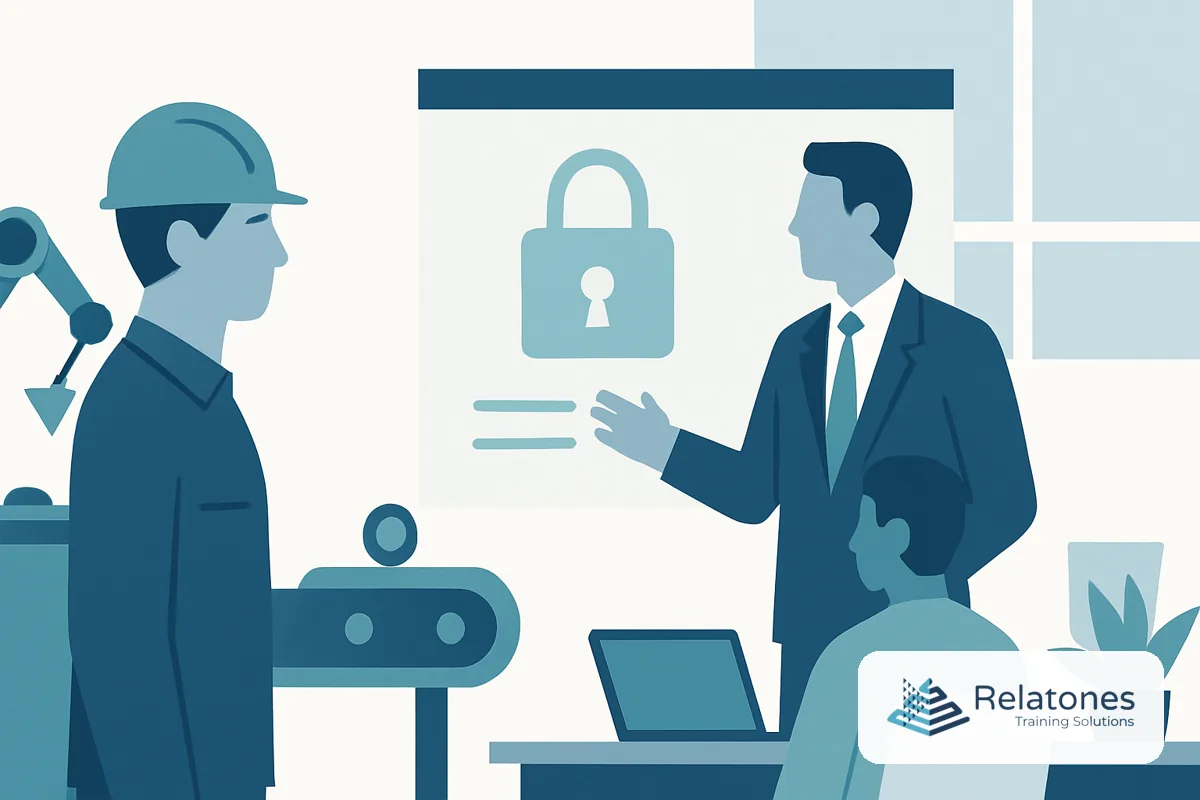
Cybersecurity training for manufacturing is employee education that teaches workers in factories and industrial firms how to recognize, avoid, and report cyber threats that can halt production, compromise connected equipment, or steal proprietary data. For US manufacturers with 50–500 employees, the stakes are higher than most owners realize—attackers have learned that a mid-sized plant with connected machinery and no dedicated security team is an easier target than a Fortune 500 enterprise. This article explains what effective training covers, how to build a program without an internal L&D team, and what happens when you skip it.
New to this topic? Start with our complete cybersecurity awareness training guide, or book a free demo to see how a role-based session runs for a manufacturing workforce.
Why Cybersecurity Training for Manufacturing Matters Now
Manufacturing is no longer a secondary target. According to Huntress, the sector made up roughly 17% of all cyberattacks in 2025—nearly double its 9% share in 2024. In 2024, the average breach cost for a manufacturing firm hit $5.56 million, up $830,000 from the prior year. These are not abstract statistics. For a 200-person plant, a single ransomware event means halted production lines, delayed shipments, and a ransom demand that, according to Sophos, averages $2 million in the manufacturing sector alone—more than double the cross-industry figure.
The root cause is usually human. Verizon’s 2025 DBIR found that system intrusion, social engineering, and basic web application attacks account for 96% of breaches—all threat categories that trained employees can interrupt. Yet only 34% of companies provided social engineering awareness training in a recent survey cited by the same report. That gap is where attackers operate.
Small and mid-sized manufacturers face additional pressure from OEM customers, insurers, and federal frameworks like CMMC/NIST SP 800-171. The DoD’s small-business cybersecurity resources make clear that defense contractors and subcontractors must demonstrate security awareness training. Insurers are asking detailed questions about training frequency and phishing simulation results before they issue—or renew—cyber coverage. The cost of not training is now measured in denied claims and lost contracts, not just incident response bills.
What Cybersecurity Training for Manufacturing Should Cover
A strong program for manufacturers goes well beyond generic phishing slides. It maps content to the actual threats workers encounter—on the shop floor, in the office, and on mobile devices—and it accounts for the reality that many employees share kiosks, work rotating shifts, and have never taken a formal IT course.
Here are the core topics every manufacturing cybersecurity training program should include:
- Phishing and social engineering - Workers need to recognize emails disguised as shipping notices, vendor invoices, or maintenance scheduling alerts—the exact lures attackers use in B2B manufacturing environments.
- Ransomware awareness - Employees should understand how ransomware enters a network (often via a single click), what it can do to production systems, and how fast they need to report something suspicious.
- OT and ICS device safety - Plant-floor staff need specific guidance: never plug an unknown USB drive into a control network, report unfamiliar devices near HMIs or PLCs, and escalate anomalies without attempting a DIY fix that could worsen a safety situation.
- Password hygiene and MFA - Strong, unique passwords and multi-factor authentication apply to office systems, remote access portals, and any cloud-connected production platform.
- Mobile and shared-device risks - Workers using tablets, shared kiosks, or personal phones to access company systems represent an undermonitored attack surface; training must address what “safe use” looks like on those devices.
- Incident reporting - Speed matters. Employees who know exactly where and how to report a suspicious email or device reduce dwell time and limit damage.
For a deeper look at how these topics connect to broader workforce awareness, see our complete cybersecurity awareness training guide.
How to Build a Manufacturing Cybersecurity Training Program (Step by Step)
You do not need an internal L&D team to run an effective program. You need a clear structure, external content, and a commitment to consistency.
-
Assess your risk profile first - Use the NIST MEP Cybersecurity Assessment Tool to identify your top three to five vulnerabilities before you buy a single training module. A plant running legacy PLCs with vendor remote access has different priorities than a warehouse managing cloud-connected inventory systems.
-
Define training tiers by role - All employees need baseline awareness (phishing, passwords, reporting). OT-exposed staff—operators, maintenance leads, engineers—need scenario-based content tied to control systems. IT and technical staff need deeper incident response and secure configuration skills. Mixing all three into one generic module wastes time and loses every audience.
-
Choose a platform that supports role-based delivery and tracking - Look for a vendor that assigns content by job function, tracks completion, and produces reports you can hand to an insurance auditor or customer questionnaire. Completion rates matter; phishing-click rates matter more.
-
Deliver training in short, frequent bursts - Monthly five-minute modules outperform annual two-hour sessions for behavior change. Integrate cyber segments into existing safety meetings and toolbox talks so training feels like part of operations, not an IT imposition.
-
Run phishing simulations on realistic lures - Simulate emails that look like supplier communications, shipment delay alerts, or maintenance scheduling requests—not generic “you’ve won a prize” templates. The closer the scenario is to real work, the more likely workers remember the lesson.
-
Test your incident response with a tabletop exercise - At least once a year, walk plant operations, procurement, and finance staff through a ransomware or OT-disruption scenario. Document the exercise for auditors and use the gaps to update next year’s training priorities.
-
Track meaningful metrics, not just completion - Phishing-click rates, time-to-report, and near-miss incident counts give leadership real evidence of risk reduction. Completion rates alone will not satisfy an insurer who asks, “Is your training working?”
Skipping steps 1 and 2 is the most common mistake. Without a risk assessment and role mapping, manufacturers end up with ad hoc programs that cannot answer a single auditor question and do not change the behaviors that actually cause incidents.
Assess My Team → Free. 10 minutes. No commitment.
The Manufacturing Cyber Training Tier Framework
This four-tier structure lets HR, IT, or operations leads run a credible program without building curriculum from scratch. Use it as a starting template, then adjust based on your NIST MEP assessment results.
- Tier 1 — All employees (shop floor and office): Phishing recognition, password hygiene, safe USB and device use, physical security basics, and how to report suspicious activity. Goal: stop the most common attack entry points.
- Tier 2 — OT/ICS-exposed staff (operators, maintenance, engineering): What to do when an HMI behaves oddly, why unknown devices must never touch a control network, safe vendor remote access procedures, and escalation paths that do not risk a safety incident. Goal: protect production continuity.
- Tier 3 — Technical and IT staff: Incident response, secure configuration, log monitoring, NIST/CMMC control implementation, and vendor risk management. Goal: build and maintain a defensible architecture.
- Tier 4 — Cyber champions and future analysts: Deeper programs aligned with frameworks like NIST SP 800-171 and manufacturing-specific credentials. Goal: create internal advocates who can coordinate with MSSPs, interpret audit findings, and lead resilience exercises.
The SBA’s cybersecurity guidance and NIST’s small-business resources both support a tiered, role-based approach as the baseline expectation for small and mid-sized businesses. Expert-led training beats DIY here because an external provider brings ready-made scenarios, phishing simulation infrastructure, and reporting tools that would take months to build internally—if you could staff them at all.
Training Delivery Format Comparison
| Format | Best for | Drives behavior change? | Notes |
|---|---|---|---|
| Blended | Multi-shift plants with mixed digital literacy | Strong | Combines self-paced modules with live virtual or in-person sessions; best for reaching all tiers and documenting completion |
| Live Virtual | Office and engineering staff; OT tabletop exercises | Strong | Instructor-led scenarios and Q&A drive engagement; easier to schedule across locations than in-person |
| Live In-Person | OT/ICS workshops; incident response tabletops; new-hire orientation | Strong for OT | Highest engagement for hands-on practice; resource-intensive but valuable for Tier 2–3 staff |
| Self-Paced Only | Supplemental refreshers; compliance recordkeeping | Limited | Adequate for baseline awareness documentation; insufficient as the primary format for behavior change in manufacturing |
For cybersecurity behavior change in manufacturing, blended delivery is the default recommendation. Self-paced modules work as reinforcement, not as the foundation.
How Relatones Approaches Cybersecurity Training for Manufacturing
Relatones starts with a gap assessment before any content is built or assigned. For manufacturing clients, that means mapping your workforce by role—plant operators, maintenance leads, engineering, procurement, office staff—and identifying where your actual exposure lives, whether that is phishing susceptibility, OT device handling, or vendor access procedures. From there, training is built around real scenarios your workers encounter: a supplier email asking for an urgent wire transfer, a USB drive found near a CNC machine, an HMI showing unexpected behavior during a shift.
Content is delivered in short modules that fit around production schedules, reinforced with phishing simulations that use lures specific to manufacturing contexts, and tracked with metrics your leadership team can actually use—click rates, time-to-report, completion by role and shift. Relatones also helps clients organize training records into audit-ready documentation, which matters when an insurer, OEM customer, or CMMC assessor asks for evidence. The outcome is a workforce that recognizes threats faster, reports them sooner, and costs significantly less to recover from when an incident does occur.
Frequently Asked Questions
How often should manufacturing employees receive cybersecurity training?
Annual training alone is not enough. Short monthly modules—five minutes or less—combined with periodic phishing simulations keep threat awareness current without pulling workers off the line for long stretches. The goal is repeated reinforcement, not a once-a-year checkbox.
What cybersecurity topics matter most for shop-floor workers?
Shop-floor employees need to recognize phishing emails disguised as shipping notices or vendor communications, understand the risks of unknown USB drives near control equipment, and know exactly how to report something suspicious. Scenarios grounded in their daily environment produce far better behavior change than generic IT-security slides.
How does cybersecurity training help with cyber insurance requirements?
Insurers routinely ask applicants whether employees receive security awareness training and whether phishing simulations are conducted. Documented, role-based training with completion records and phishing-click metrics gives underwriters evidence of risk controls, which can reduce premiums or prevent coverage exclusions after a ransomware claim.
Do we need separate training for IT staff and OT or plant-floor staff?
Yes. IT staff need depth in incident response, secure configuration, and vendor risk management. OT and plant-floor staff need scenario-based awareness tied to control systems—what to do when an HMI behaves oddly, why unknown devices must never be plugged into a control network, and how to escalate safely without stopping production.
How does AI change the cyber threat picture for manufacturers?
Attackers now use AI to craft convincing phishing emails, generate realistic supplier impersonations, and automate reconnaissance against industrial targets. Training must evolve alongside these tools, teaching employees to question urgency-based requests, verify unexpected communications through a second channel, and trust their instincts when something feels wrong—even if the email looks perfect.
The Cost of Waiting Is Measured in Downtime, Not Training Hours
Manufacturing is now one of the most targeted sectors in the US, and Verizon’s data makes clear that the attacks succeeding are the ones employees could have stopped. A role-based, scenario-driven training program—built around your actual workforce and OT environment—is the most cost-effective control available to a 50–500 employee manufacturer without a dedicated security team. Start by identifying where your gaps are, then build from there.
Assess My Team → Free. 10 minutes. No commitment.
Sources & References
Every statistic in this article is drawn from primary, US-based research. Explore the original sources below.
- 12025 Data Breach Investigations Report
- 2The State of Ransomware 2024: Manufacturing and Production
- 3Cybersecurity Resources for Manufacturers
- 4Small Business Cybersecurity Corner
- 5Strengthen Your Cybersecurity
- 6Cybersecurity Resources for Small Businesses in the Defense Supply Chain
- 7Manufacturing Cybersecurity Trends
- 8Cybersecurity Compliance for U.S. Manufacturers in 2025