
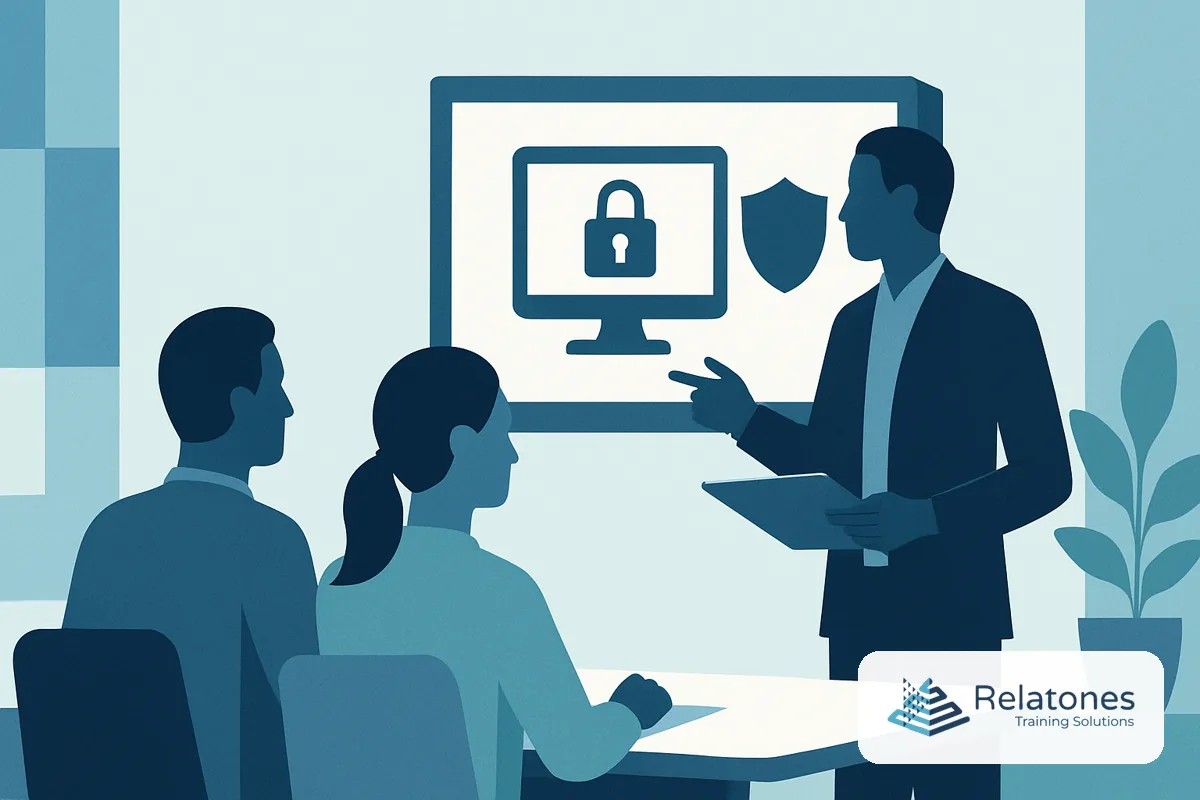
Data breach prevention training is structured cybersecurity education that teaches employees to recognize phishing, handle sensitive data correctly, use multi-factor authentication, follow secure password practices, and report suspicious activity before it becomes a breach. For US companies with 50–500 employees, it is the most direct way to address the human behavior that attackers exploit most. The average cost of a US data breach reached $10.22 million in 2025, according to the IBM Cost of a Data Breach Report 2025—a figure that dwarfs almost any training investment. If your team has no internal L&D function and security training has been a once-a-year checkbox, this guide shows you a practical path forward.
New to this topic? Start with our cybersecurity awareness training guide for a full overview of how awareness programs work, or explore our employee cybersecurity awareness training program to see how Relatones builds these programs for US mid-market teams.
Why Data Breach Prevention Training Matters Now
Human error is not a secondary breach vector—it is the primary one. Research consistently points to employee mistakes, phishing clicks, and poor credential hygiene as the most common entry points for attackers. The FTC’s cybersecurity guidance for small businesses is direct: train staff regularly, keep them updated on new risks, and have an incident response plan in place before an attack happens. That is not aspirational advice—regulators are increasingly treating the absence of documented training as an aggravating factor in enforcement actions and audit findings.
CISA’s resources for small and medium-sized businesses recommend that all staff receive formal security training and know how to report suspicious activity—alongside MFA, patching, and other baseline controls. The word “formal” matters. Ad hoc reminders and all-staff emails do not satisfy the bar regulators and cyber insurers are raising. According to the NICCS Data Protection & Lifecycle Management course catalog, identity theft alone victimizes roughly 15 million US adults each year, with total losses exceeding $50 billion annually—and businesses spend another $50 billion per year on identity-theft-prevention measures. Training is the control that reduces the demand for those reactive costs.
The business case is equally clear on the upside. Organizations with effective security awareness programs are materially less likely to appear on public breach lists, and companies with extensive training save significantly per breach compared to those without it. Framing training as an expense misses the point: it is insurance against costs that are orders of magnitude larger.
What Data Breach Prevention Training Should Cover
The goal of a strong program is not awareness for its own sake—it is behavior change that holds up under real attack conditions. Every employee who touches company systems, email, or customer data needs baseline coverage. Higher-risk roles need more.
- Phishing and social engineering — Recognizing deceptive emails, fake login pages, voice phishing (vishing), and AI-assisted lures that bypass older pattern-recognition instincts.
- Password hygiene and password managers — Why reused or weak passwords are a primary credential-theft vector, and how to use a password manager correctly. Do not assume employees understand the risk—make the right behavior the default.
- Multi-factor authentication (MFA) — How MFA works, why it is non-negotiable, and how to recognize MFA-fatigue attacks where attackers flood an employee with approval requests.
- Data classification and handling — Which data is sensitive, how to store and share it safely, and what not to do with personal or financial records in email or unsecured file-sharing tools.
- Secure remote work and device practices — Home network risks, public Wi-Fi exposure, and how to keep endpoints protected outside the office.
- Incident and breach reporting — The single most underemphasized topic. Employees need a one-page “breach red card” that tells them exactly who to contact, what to say, and what not to do the moment something looks wrong.
For teams in finance, HR, or executive leadership, add role-specific modules on business email compromise (BEC), deepfake impersonation, and wire transfer verification. These groups are disproportionately targeted and face consequences that go well beyond a single compromised account.
How to Build a Data Breach Prevention Training Program
A workable program for a company without an internal L&D team does not require building anything from scratch. It requires choosing the right partner and running five repeatable steps.
- Assess your current exposure — Identify which roles have access to sensitive data, which systems are in scope for compliance frameworks like HIPAA or PCI DSS, and whether your team has had any security training in the past 12 months. Gaps here define your starting point.
- Select a managed security awareness platform — Choose a vendor that provides ready-to-run content, phishing simulations, reporting dashboards, and admin support. NIST’s small business cybersecurity training resources catalog vetted options, including free and low-cost programs suitable for teams without dedicated security staff.
- Run baseline phishing simulations before training starts — This gives you a pre-training click rate to measure against, and it tells you which employees and departments need the most attention. Use results for coaching, not punishment.
- Deploy role-based training in short modules — Onboarding training for every new hire. Quarterly microlearning for the full team. Role-specific content for finance, HR, and administrators. Keep each module under 15 minutes—completion rates drop sharply for longer sessions.
- Pair training with technical controls — Training is not a substitute for MFA, patching, encryption, and least-privilege access. The NIST cybersecurity awareness and workforce development framework makes this explicit: human controls and technical controls reinforce each other. Neither works as well alone.
Skipping the simulation step means you have no baseline and no way to demonstrate improvement to a cyber insurer or auditor. Skipping role-based content means your highest-risk employees receive the same generic training as someone with no access to financial systems.
Assess My Team → Free. 10 minutes. No commitment.
The Breach-Prevention Minimum: A Practical Framework
For a US SMB with no internal L&D function, the following schedule represents the practical minimum that satisfies common compliance expectations and meaningfully reduces human risk. Use it as a starting checklist.
- Onboarding training — Every new hire completes security awareness training before accessing production systems. Cover phishing, passwords, MFA, data handling, and reporting in one focused session.
- Monthly or quarterly phishing simulations — Simulated phishing emails that mirror current attack styles. Follow each simulation with immediate, non-punitive coaching for anyone who clicked.
- Quarterly microlearning refreshers — Short modules (under 10 minutes) on rotating topics: MFA fatigue, AI-generated phishing, password manager use, and safe file sharing. Keep content current—last year’s examples feel dated and employees disengage.
- Annual tabletop exercise for managers — Walk department heads and potential incident responders through a realistic breach scenario. The FTC’s Data Breach Response Guide for Business outlines the response steps your team should be able to execute without reading a manual during an incident.
- Immediate retraining after real incidents or repeated simulation failures — Anyone who fails two consecutive phishing simulations gets a targeted coaching session, not a policy reminder. Real incidents trigger a team-wide refresher within 30 days.
- Documented completion records — Every training session generates a completion record. Store these for at least 12 months. Auditors, insurers, and—in a breach scenario—the US Secret Service’s cyber incident guidance will ask for evidence of your program.
This framework is not the ceiling—it is the floor. Regulated industries, particularly healthcare and financial services, will need additional controls and more frequent documentation to satisfy HIPAA, PCI DSS, or state privacy law requirements. But this schedule is where every team should start.
Delivery Format Comparison
| Format | Best for | Drives behavior change? | Notes |
|---|---|---|---|
| Blended | Teams needing compliance records plus real skill transfer | Strong | Combines live instruction with scenario practice and async reinforcement—ideal for most US SMBs |
| Live Virtual | Distributed teams, time-zone flexibility | Strong | Works well for phishing debrief sessions and tabletop exercises with remote participants |
| Live In-Person | High-risk role groups, tabletop exercises | Strong | Best for finance, HR, and executive sessions where discussion depth matters |
| Self-Paced | Policy acknowledgment, onboarding documentation | Limited | Acceptable for baseline policy attestation; alone, it is insufficient for behavior change |
Self-paced modules have their place—they are efficient for onboarding documentation and annual policy sign-offs. They should not be the primary delivery method for phishing awareness or any content where you need employees to actually change how they act under pressure.
How Relatones Approaches Data Breach Prevention Training
Relatones builds data breach prevention training programs for US companies that have no internal L&D team and cannot afford to guess at what their employees actually need. The process starts with a role-based gap assessment: who has access to what, which compliance frameworks apply, and where the riskiest behaviors currently live. From there, Relatones designs training that matches real job contexts—finance teams practice recognizing BEC attempts, not abstract phishing examples, and customer-facing staff work through data-handling scenarios that reflect their actual workflows.
Every program includes phishing simulations tied to coaching, not blame—because the NIH-published research on security awareness training is clear that punitive approaches reduce reporting rates and make breaches harder to catch early. Reinforcement happens through short quarterly modules, not a single annual event. At the end of each cycle, teams receive documented completion records and measurable improvement data—the evidence that cyber insurers and compliance auditors ask for when something goes wrong. The outcome is a team that catches threats earlier, reports incidents faster, and costs significantly less to protect.
Frequently Asked Questions
How does employee training prevent data breaches?
Training reduces the human errors that attackers exploit most—phishing clicks, weak passwords, and mishandled sensitive data. When employees recognize threats early and know exactly how to report them, the window for a breach to escalate shrinks dramatically. Pairing training with technical controls like MFA and patching makes the combination far more effective than either alone.
How often should data breach prevention training be repeated?
Most security frameworks and regulators treat annual training as a floor, not a ceiling. Best practice for US SMBs is short onboarding training for new hires, monthly or quarterly phishing simulations, and quarterly microlearning refreshers on current threats. One-time annual modules leave employees unprepared as attack tactics evolve throughout the year.
Which employees need data breach prevention training?
Every employee with access to company systems, email, or sensitive data needs baseline training. Finance, HR, executives, and IT administrators face higher-risk targeting and benefit from role-specific modules covering wire fraud, social engineering, and privileged access. Contractors and vendors with system access should be included as well.
What compliance regulations require security awareness training?
Several US frameworks treat documented training as a required control. HIPAA mandates security awareness training for covered entities and their business associates. PCI DSS requires organizations handling card data to train staff on security policies. California’s CCPA/CPRA and broader FTC guidance also expect reasonable security practices, which regulators increasingly interpret to include documented employee training.
What topics should data breach prevention training cover?
Effective programs cover phishing and social engineering recognition, password hygiene and password managers, multi-factor authentication, data classification and handling, secure remote work and device practices, and how to report a suspected incident. Role-based modules for higher-risk teams—finance, HR, and executives—address targeted threats like business email compromise and deepfake impersonation.
The Cost of Waiting Is Not Abstract
Every month without a structured data breach prevention training program is a month where your employees make high-risk decisions without the knowledge to make better ones. The IBM Cost of a Data Breach Report 2025 puts the average US breach cost at $10.22 million—a number built from downtime, legal fees, regulatory penalties, and customer loss, not just IT remediation. A documented, role-based training program is the most cost-effective control available to a mid-market US team, and it is the one control that also satisfies compliance auditors, cyber insurers, and the regulators who will ask what you did to prevent a breach from happening.
Assess My Team → Free. 10 minutes. No commitment.
Sources & References
Every statistic in this article is drawn from primary, US-based research. Explore the original sources below.
- 1Training | NIST
- 2Cybersecurity for Small Business | Federal Trade Commission
- 3Small and Medium-Sized Business Resources | CISA
- 4Security Awareness Training for the Workforce: Moving Beyond Check-the-Box Compliance
- 5Data Breach Response: A Guide for Business | Federal Trade Commission
- 6Data Protection & Lifecycle Management Course | NICCS
- 7Cybersecurity Awareness, Education, and Workforce Development | NIST
- 8Preparing for a Cyber Incident | US Secret Service