
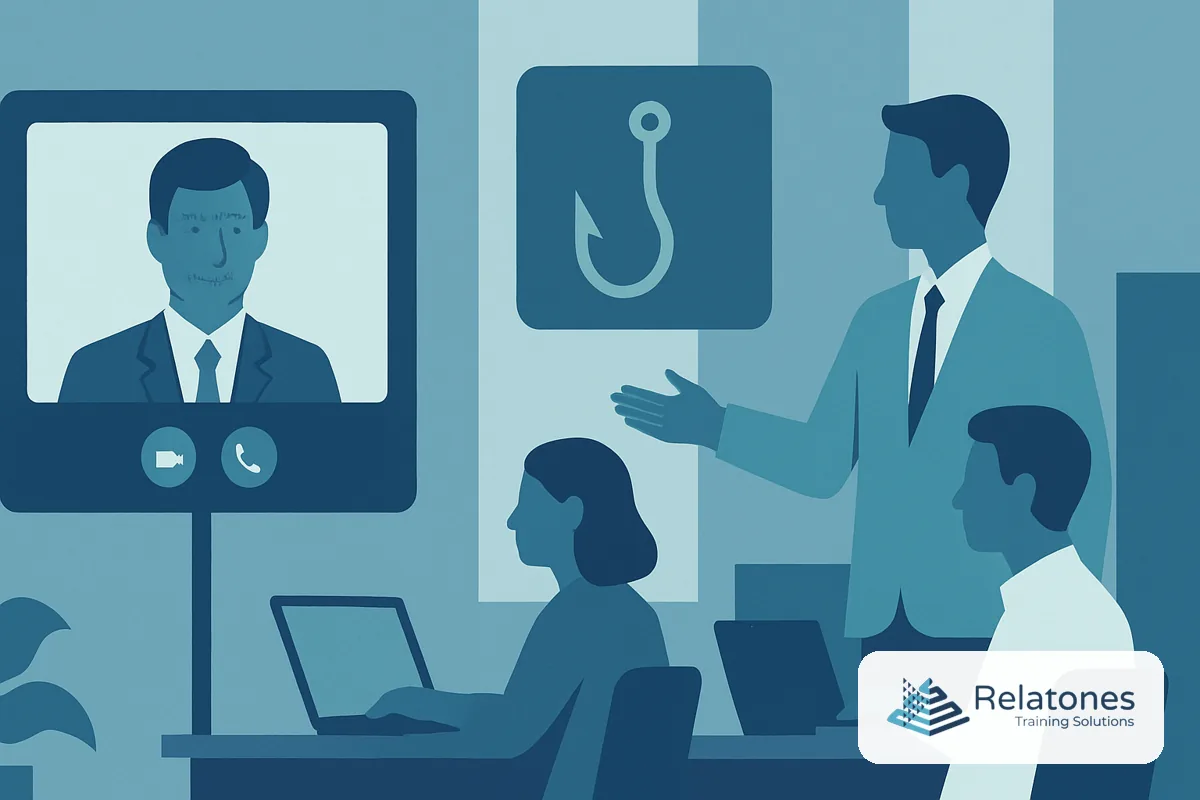
Deepfake phishing training for employees is simulation-based security awareness training that exposes staff to realistic AI-generated voice and video impersonation scams so they learn to spot and safely handle them before a real incident occurs. Generative AI has made these attacks cheap to produce, convincing enough to fool experienced professionals, and common enough that 92% of businesses have already absorbed financial consequences from synthetic media fraud. This guide covers what effective training includes, which roles to prioritize, how to run it without an internal L&D team, and what metrics actually matter. If your employees are still watching the same annual phishing video—one that covers email typos but says nothing about fake CFO video calls—this is the gap that needs closing.
New to this topic? Start with our complete cybersecurity awareness training guide, or book a free demo to see how a role-specific simulation session runs.
Why Deepfake Phishing Training Matters Now
The attacks your employees face today look nothing like the ones covered in most annual training modules. Deepfake fraud attempts surged 2,137% in 2024, and Q1 2025 alone recorded more deepfake incidents than all of 2024 combined. The technology behind these attacks—voice cloning, face synthesis, real-time video manipulation—costs almost nothing to use and produces results that are genuinely hard to question in the moment.
The financial stakes are concrete. A single deepfake video-call scam cost one engineering firm $25.6 million when an employee wired funds after what appeared to be a legitimate call with the CFO. That is not an outlier scenario reserved for large enterprises. For a company with 50 to 500 employees, a $250,000 to $500,000 wire fraud is an existential event, not a budget line item. Verizon’s 2026 Data Breach Investigations Report found the human element involved in 62% of confirmed breaches—and synthetic media is engineered specifically to exploit the people employees already trust.
The deeper problem is that most existing training programs were built for a different threat. Older modules teach staff to look for misspelled domains and generic greetings. Deepfake attacks remove every one of those signals. The voice sounds right. The face looks right. The urgency feels real. Traditional awareness training leaves a hidden gap around real-time voice and video decision-making that attackers are actively exploiting right now.
What Deepfake Phishing Training Should Cover
Effective training does more than explain what a deepfake is. It builds a repeatable habit: pause, verify through a separate trusted channel, escalate without embarrassment. That habit has to be practiced under realistic pressure, not just described in a slide deck.
A complete program covers these components:
- Deepfake mechanics—How AI clones voices and synthesizes video, why the results are convincing, and why “it looked real” is not a reliable defense against a well-crafted attack.
- Attack patterns by channel—Fake executive calls requesting urgent wire transfers, cloned vendor voices changing payment details, deepfaked video meetings asking for credential access, and hybrid email-plus-phone sequences that escalate pressure.
- Red flags that hold up in 2026—Unusual urgency, requests for secrecy, pressure to skip normal approval steps, and asks that arrive through an unexpected channel. These behavioral signals survive even when audio and video quality is flawless.
- Out-of-band verification procedures—A simple, practiced habit of calling back on a known number or using an internal pre-approved process before acting on any unusual financial or access request.
- Role-specific scenarios—Finance staff practicing fake CFO payment calls, HR staff handling deepfaked onboarding requests, and executive assistants recognizing impersonated leadership over Teams or WhatsApp.
- Reporting pathways—A clear, low-friction process for flagging suspicious contacts so that hesitation or embarrassment does not delay escalation.
For a broader look at building the full program structure, see our cybersecurity awareness training guide.
How to Build a Deepfake Phishing Training Program (Step by Step)
This structure works for companies with 50 to 500 employees and no dedicated L&D team. Each step is designed to produce measurable behavior change, not just documented attendance.
- Map your highest-risk roles and workflows. Identify who handles wire transfers, payroll changes, vendor payment updates, credential resets, and executive approvals. Finance, HR, procurement, and executive assistants are almost always the priority. If finance or HR showed up as high-risk in your initial mapping, confirm their baseline scores before training begins so you have a clean comparison point afterward.
- Run a baseline simulation before any formal training. Send a simulated deepfake phishing attempt—ideally email plus one voice or video channel—to your priority group. Record failure rates and reporting rates. This baseline is your proof of starting point for insurers, auditors, and leadership.
- Deliver a short role-specific education module. Keep it under 15 minutes. Cover how deepfakes work, the specific attack patterns that target their role, the red flags that matter, and the exact verification step you want them to take. Employees need practice against the attacks they’re actually facing—generic AI content awareness courses do not meet that bar.
- Introduce and enforce a written verification policy. One page. It states that any request to transfer funds, change payment details, reset credentials, or approve sensitive access must be confirmed through a separate trusted channel before action is taken. No exceptions for urgency. No exceptions for executives.
- Run monthly simulations and assign immediate microlearning on failure. After a failed simulation, send a two-to-three minute module explaining exactly what the red flag was and what the correct response looks like. Long remedial courses assigned days later produce poor retention. Immediate, specific feedback produces behavior change.
- Track behavior metrics, not completion rates. Monitor simulation failure rates by role, reporting rates, and time-to-report. Share a simplified version of these metrics with leadership each quarter. This is the evidence that a program is working—and the evidence cyber insurers and enterprise customers increasingly require.
Skipping the baseline simulation means you have no proof of improvement. Skipping the verification policy means training alone will not prevent a determined attacker from pressuring an employee past their learned instincts.
Assess My Team → Free. 10 minutes. No commitment.
The Verification-First Framework
The single most important habit deepfake phishing training can build is verification before action. Every other skill—recognizing urgency, questioning an unusual request, spotting a channel mismatch—leads to the same moment: the employee must decide whether to act or pause and confirm.
A practical framework for that moment:
- STOP—Any request involving money, access, or sensitive data that arrives unexpectedly or under time pressure requires a pause.
- SEPARATE—Do not reply through the channel the request came in on. A deepfake video call is not verified by calling back on the same number shown on screen.
- VERIFY—Use a pre-established trusted contact method: a known internal phone number, a pre-shared verification phrase, or a dual-approval workflow already in your system.
- REPORT—Whether the request turns out to be real or a scam, log it through your incident reporting channel. High reporting rates are a leading indicator of a healthy security culture.
This framework is simple enough to apply under real pressure—which is exactly when deepfake attacks are designed to be most effective. Hook Security’s deepfake awareness training guidance notes that the goal is to build a reporting culture where employees feel safe flagging suspicious contacts immediately, not after second-guessing themselves for an hour.
Pairing this framework with structural controls—dual approval requirements for transfers, MFA on sensitive systems, centralized incident reporting—means the program does not rely entirely on human judgment in a high-pressure moment. Adaptive Security’s SMB guidance makes the same point: behavioral training works best when it is backed by process controls that catch mistakes even when training does not.
Training Format Options
| Format | Best for | Drives behavior change? | Notes |
|---|---|---|---|
| Blended (modules + live simulations) | Most SMBs without internal L&D | Strong | Combines education with practiced response; highest retention for complex, multi-channel threats |
| Live Virtual (instructor-led) | High-risk role groups like finance or HR | Strong | Allows scenario Q&A and real-time pressure drills; good for initial role-specific rollout |
| Live In-Person | Executive teams and leadership | Strong | Best for tabletop exercises and wire-transfer scenario walkthroughs |
| Self-Paced (async modules only) | Broad baseline awareness only | Limited | Does not build the real-time decision habits deepfake attacks exploit; use as a supplement, not a primary format |
How Relatones Approaches Deepfake Phishing Training
Relatones starts with a role-based risk assessment to identify which teams—typically finance, HR, and executive support—face the highest exposure from voice and video impersonation attacks. From there, training is built around the specific scenarios those roles encounter: fake CFO payment calls, cloned vendor voice requests, and manipulated video meeting approvals. Employees practice the verification-first habit in realistic simulated scenarios, not abstract case studies. After each simulation round, Relatones helps clients review behavior metrics—failure rates, reporting rates, repeat-risk by role—and uses that data to sharpen the next campaign rather than repeat the same content. The result is a team that responds faster, reports more consistently, and gives leadership the documented evidence of improvement that cyber insurers and enterprise customers are increasingly asking to see. Book a demo to see how the role-specific simulation approach works for your team.
Frequently Asked Questions
What is deepfake phishing training for employees?
Deepfake phishing training is simulation-based security awareness training that exposes employees to realistic AI-generated voice and video impersonation scams before a real attack occurs. It combines short education modules explaining how deepfakes work with hands-on drills where staff practice spotting and safely handling fake executive calls, cloned voices, and manipulated video requests. The goal is measurable behavior change—lower click rates, faster reporting, and consistent use of out-of-band verification—not just course completion.
How common are deepfake attacks against small and mid-sized businesses?
Very common and accelerating. Deepfake fraud attempts surged 2,137% in 2024, and Q1 2025 alone recorded more deepfake incidents than all of 2024 combined. According to Regula’s Deepfake Trends 2024 report, 92% of businesses have already absorbed financial consequences from synthetic media fraud. SMBs are attractive targets precisely because smaller finance and HR teams have fewer verification checkpoints and less dedicated security staff.
Which employee roles should be prioritized for deepfake phishing training?
Finance, HR, procurement, executive assistants, and IT administrators should be trained first. These roles handle wire transfers, payroll changes, vendor updates, credential resets, and sensitive approvals—exactly the workflows deepfake attackers target with fake CFO calls or cloned executive voices. Once simulation failure rates improve in these high-risk groups, training can expand to the broader organization.
How often should employees complete deepfake phishing simulations?
Monthly simulations consistently outperform annual compliance modules for building lasting habits. Short, frequent drills across multiple channels—email, voicemail, and video—are more effective than a once-a-year exercise because they keep verification instincts sharp and expose staff to the tactics attackers actually use. After each failed simulation, a two-to-three minute microlearning module sent immediately produces better retention than a lengthy remedial course assigned days later.
What does effective deepfake phishing training measure?
Effective programs track simulation failure rates by role, phishing reporting rates, time-to-report after a suspicious contact, and repeat-risk scores for individuals who fail multiple drills. These behavior metrics give security teams and insurers auditable evidence that training is working. Completion rates and attendance records alone do not satisfy cyber insurance underwriters or enterprise customers who require documented, multi-channel security awareness programs.
Your Employees Are the Last Line of Defense—Train Them for the Attacks They’re Actually Facing
Deepfake phishing attacks are already costing US businesses millions, and the volume is accelerating every quarter. Annual email phishing modules will not prepare your finance team for a convincing fake CFO call at 4:45 on a Friday afternoon. A role-specific, simulation-based program—built around realistic scenarios, a practiced verification habit, and behavior metrics your leadership can act on—is what actually moves the risk needle. Start with a free assessment to identify which roles on your team are most exposed and where the biggest gaps are.
Assess My Team → Free. 10 minutes. No commitment.
Sources & References
Every statistic in this article is drawn from primary, US-based research. Explore the original sources below.
- 1Train Your Employees Against the Next Wave of Phishing: Deepfakes
- 2Deepfake Training for Employees
- 3Deepfake Awareness Training Platforms
- 4Deepfake Statistics 2026: The Data Security Leaders Need to Know
- 5Deepfake Awareness Training: Defend Your Organization
- 6Deepfake Awareness Training for Modern Cybersecurity
- 7Are Businesses Ready to Guard Against Deepfake Phishing Attempts?
- 82026 Data Breach Investigations Report