
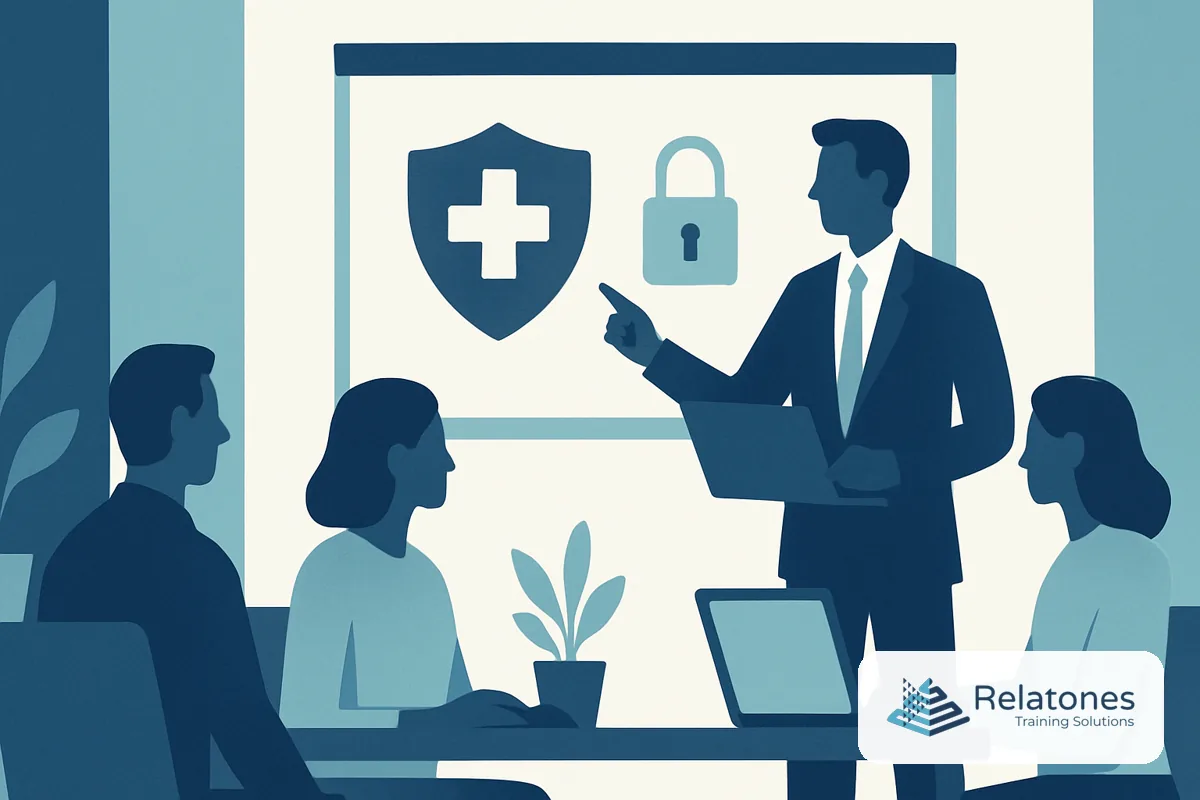
HIPAA cybersecurity training for staff is the federally required security awareness and training program that covered entities and business associates use to teach every workforce member how to protect electronic protected health information (ePHI), recognize threats, follow security policies, and report incidents. Without it, a single phishing email—or one employee who doesn’t know how to encrypt a message—can trigger a breach that shuts down operations, invites federal investigation, and costs more to fix than years of training ever would. This guide walks through exactly what the law requires, what a strong program covers, and how to build one that actually changes behavior. If your team handles patient data and you’re not sure your training program is complete, the stakes are higher than most healthcare SMBs realize.
New to this topic? Start with our cybersecurity awareness training guide, or explore our employee cybersecurity awareness training program to see how Relatones approaches security behavior change in healthcare settings.
Why HIPAA Cybersecurity Training Matters Now
Strong cybersecurity is not an add-on to your healthcare business model—it is part of the model itself. Think about what a breach actually disrupts: billing systems go offline, patient records become inaccessible, care decisions slow down. In a real ransomware scenario, the downstream effects on patient safety are not hypothetical.
The HIPAA Security Rule, codified at 45 CFR Part 164 Subpart C, explicitly requires a security awareness and training program for all workforce members. That requirement has no size exemption—it applies to a 55-person physician group the same way it applies to a 500-person clinic network. The Privacy Rule, at 45 CFR Part 164 Subpart E, adds a parallel requirement for training on PHI policies and procedures. These are not aspirational guidelines; they are enforceable federal standards.
The financial exposure is real and growing. HHS Office for Civil Rights 2025 figures place the maximum annual civil monetary penalty at $2.19 million per violation category—and that number applies per category, not per incident. IBM’s Cost of a Data Breach Report 2025 found that the average cost of a US data breach has reached $10.22 million. That figure includes investigation, remediation, notification, regulatory response, and reputational damage. Compared to that exposure, a well-structured training program is not a cost—it is risk management.
Human error is the variable training directly controls. A NIH-published study on IT security training in a large healthcare organization found that staff who completed security training were 4.2 times more likely to correctly respond to a suspicious email than those who had not. The same study found that only about a quarter of clinical staff knew how to encrypt emails when sending outside the organization—a gap that creates breach risk every single day.
What HIPAA Cybersecurity Training for Staff Should Cover
A compliant, effective program goes beyond a PDF policy read-and-sign. It translates legal requirements into behaviors that staff actually perform under pressure, in the middle of a busy shift, when a suspicious email lands in their inbox.
Here is what a complete program covers:
- HIPAA Privacy and Security Rule basics—what ePHI is, what “minimum necessary” use means, and why it matters to each role specifically.
- Phishing, malware, and social engineering recognition—how to identify suspicious emails, links, attachments, and phone calls pretending to be vendors or colleagues.
- Password hygiene and access controls—strong credential practices, multi-factor authentication, and why sharing logins is a HIPAA violation, not just a policy inconvenience.
- Safe handling of ePHI across channels—secure email, encrypted texting, file transfer, and what to never send through a standard consumer app.
- Mobile device and remote-work security—screen locks, approved apps, VPN use, and what happens when a device is lost or stolen.
- Incident recognition and reporting—what counts as a potential breach, who to notify immediately, and why fast reporting reduces legal exposure.
- Role-specific scenarios—clinical staff face different risks than billing staff; front-desk employees face different threats than IT administrators. Generic training leaves real gaps.
HHS has stated explicitly that there is no single standardized HIPAA training program that fits all entities. That is why role-based design matters. For a deeper look at building phishing-resistant teams, see our related post on how phishing attacks work and how to train your team.
How to Build a HIPAA Cybersecurity Training Program (Step by Step)
Building this program from scratch feels daunting without an internal L&D team. The path is more manageable than it looks when you break it into clear steps.
- Run a security risk analysis first. The Security Rule requires it, and it tells you which threats, workflows, and roles carry the most exposure. Your training priorities should follow your risk findings—not a generic template.
- Map training content by role. Clinical, billing, front desk, IT, and contractor staff each interact with ePHI differently. Build or select content that reflects what each group actually does, not what a hospital system does.
- Make onboarding training mandatory before ePHI access. New hires should complete core privacy and security training within their first few days—before they touch a patient record, not after.
- Schedule recurring refreshers throughout the year. Annual training is a floor, not a ceiling. Short monthly or quarterly reminders, microlearning modules, and policy update notifications keep security top of mind without overwhelming staff.
- Run phishing simulations regularly. Simulated phishing tests reveal who is at risk before a real attacker does. CISA’s cybersecurity training and exercises resources include tabletop exercise packages that can complement this work.
- Track completion, scores, attestations, and remediation. Documentation is your legal evidence. An LMS or managed training service that captures who completed what, when, and how they scored protects you during an HHS audit.
- Update content after incidents, risk changes, or new threats. Ransomware tactics evolve. Your training content should too—at minimum after every internal incident and after major threat-landscape shifts.
Skipping steps two and six are the most common mistakes. Without role-based content, training feels irrelevant and staff disengage. Without documentation, completion records that existed but were never captured become legally useless.
Assess My Team → Free. 10 minutes. No commitment.
The HIPAA Training Compliance Checklist
Use this as a practical baseline. It is not a substitute for legal counsel, but it covers the operational elements HHS expects to see during an audit.
- ☐ Security risk analysis completed and documented
- ☐ Training program scope maps to risk analysis findings
- ☐ All workforce members covered—clinical, administrative, IT, contractors
- ☐ Onboarding training completed before ePHI access is granted
- ☐ Refresher training scheduled at least annually, with periodic updates throughout the year
- ☐ Phishing simulations conducted and results tracked
- ☐ Quiz scores and knowledge checks recorded per employee
- ☐ Remediation process defined for employees who fail assessments
- ☐ Training records retained for a minimum of six years (per HIPAA documentation requirements)
- ☐ Content updated after any security incident or material policy change
A managed training service handles most of this infrastructure automatically—curriculum delivery, reminder scheduling, quiz scoring, and reporting in one place. For teams without a dedicated compliance function, that matters. Building all of this internally competes directly with clinical and operational workloads, and the overhead is real.
NIST’s small-business cybersecurity training guidance, available through the NIST Small Business Cybersecurity Corner, recommends building a cybersecurity and privacy learning program that includes awareness campaigns, role-based training, and ongoing workforce education—language that maps directly onto HIPAA’s requirements and is worth bookmarking.
Delivery Format Comparison
| Format | Best for | Drives behavior change? | Notes |
|---|---|---|---|
| Blended | All-staff HIPAA programs with role-based modules + live Q&A | Strong | Best overall approach; combines eLearning efficiency with live discussion for complex topics like incident response |
| Live Virtual | Role-specific cohorts, tabletop exercises, leadership sessions | Strong | Effective for smaller groups; works well for high-risk roles like billing, IT, and clinical leads |
| Live In-Person | New-hire onboarding, annual kick-off, remediation sessions | Strong | High engagement; harder to scale across multiple locations |
| Self-Paced | Policy acknowledgment, foundational awareness modules | Limited | Appropriate for baseline coverage only; insufficient as the sole delivery method for behavior-critical topics |
Never rely on self-paced eLearning alone for HIPAA cybersecurity training. The behavior changes that prevent breaches—recognizing a phishing attempt in real time, knowing when to escalate a suspicious request—require practice, feedback, and reinforcement that static modules cannot provide on their own.
How Relatones Approaches HIPAA Cybersecurity Training
Relatones starts every HIPAA training engagement with an assessment of the client’s actual risk profile and workforce composition—not a generic content library drop. From there, training is designed by role: what a front-desk employee needs to know about ePHI handling differs from what an IT administrator needs to understand about access controls, and both differ from what a billing supervisor needs around secure email practices.
Delivery is blended by default: self-paced foundational modules for efficiency, live virtual or in-person sessions for the scenarios that require discussion and practice, and phishing simulations run on a recurring schedule to test real-world readiness. Every completion, quiz score, and simulation result is tracked and reportable—because documentation is not optional under HIPAA, and our clients should never scramble to produce training records during an audit. The outcome is a team that is measurably more prepared to protect patient data, with the documentation to prove it.
Frequently Asked Questions
Does every employee need HIPAA cybersecurity training, or just clinical staff?
Every member of the workforce at a covered entity or business associate must receive security awareness and training—clinical staff, billing, front desk, IT, management, and contractors under your organization’s control. The HIPAA Security Rule does not carve out non-clinical roles. The content and emphasis should be tailored by role, but coverage must be universal.
How often does HIPAA cybersecurity training need to happen?
HIPAA requires an ongoing security awareness and training program, not a single annual event. HHS describes the program as evolving, which means content must be updated when threats, systems, or policies change. Most compliance guidance treats annual refresher training as a floor, not a ceiling, and recommends periodic reminders, phishing simulations, and just-in-time updates throughout the year.
What happens if a breach occurs and training records are incomplete?
Incomplete training documentation can be used against your organization during an HHS Office for Civil Rights investigation. Missing records can support a finding of willful neglect, which carries the highest HIPAA civil monetary penalties—up to $2.19 million per violation category annually, according to HHS Office for Civil Rights 2025 figures. Documentation is not just an administrative task; it is your legal evidence of compliance.
Is the phishing click rate a useful metric for HIPAA training programs?
Yes. Tracking whether the phishing simulation click rate declines quarter over quarter tells you whether training is changing real behavior, not just producing completion certificates. A flat or rising click rate after training is a signal that content, format, or frequency needs adjustment. Pair click-rate trends with quiz scores and incident report volume for a complete picture.
What does escalation look like when a high-risk employee needs targeted intervention?
A well-structured program flags employees who repeatedly fail phishing simulations, score below passing on knowledge checks, or appear in incident reports. Escalation typically means targeted one-on-one or small-group retraining focused on the specific gap, followed by a retesting window and documented remediation. The goal is behavior change, not punishment—but the documentation of each step protects the organization if that employee is later involved in a breach.
Your Training Program Is Either Protecting You or Exposing You
There is no neutral position with HIPAA cybersecurity training for staff. Either your workforce knows how to recognize a phishing attempt, handle ePHI correctly, and report an incident fast—or they don’t, and a breach is a matter of when, not if. The Security Rule requirement exists because patient data deserves protection, and because the cost of a breach—financial, operational, and reputational—dwarfs the cost of a well-run training program. Start by assessing where your team actually stands.
Assess My Team → Free. 10 minutes. No commitment.
Sources & References
Every statistic in this article is drawn from primary, US-based research. Explore the original sources below.
- 1eCFR :: 45 CFR Part 164 Subpart C -- Security Standards for the Protection of Electronic Protected Health Information
- 2eCFR :: 45 CFR Part 164 Subpart E -- Privacy of Individually Identifiable Health Information
- 3CERTIFIED HIPAA SECURITY TRAINING CHSE® from Supremus Group LLC | NICCS
- 4Training | NIST
- 5Assessing staff awareness and effectiveness of educational training on IT security and privacy in a large healthcare organization - PMC
- 6Cybersecurity Training & Exercises | CISA