
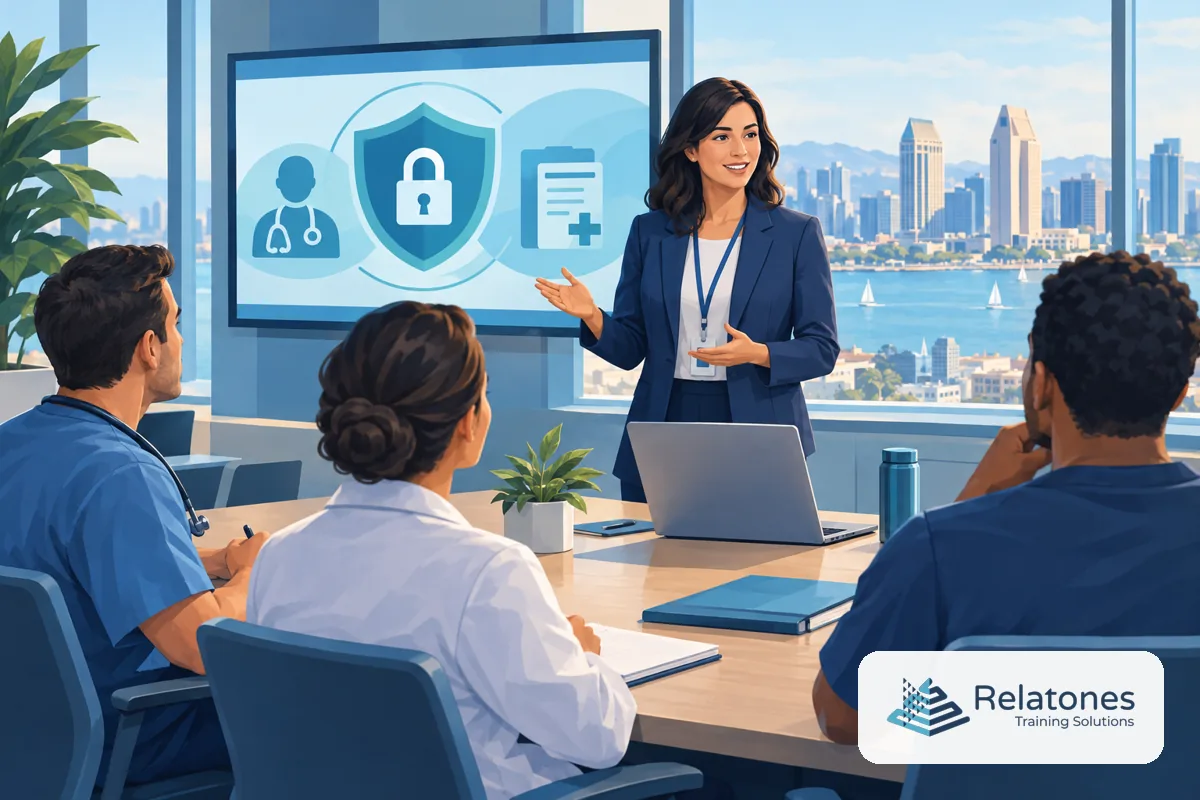
HIPAA training for San Diego healthcare organizations is a federally required workforce education program that teaches employees, contractors, and vendors how to handle protected health information (PHI) in compliance with the Privacy, Security, and Breach Notification Rules. Without a documented, role-based training program, a San Diego medical practice, billing company, laboratory, or health-tech vendor faces regulatory penalties, breach liability, and real difficulties winning or keeping contracts with hospitals and health plans. This article covers what the law requires in 2026, what effective training looks like for a 50- to 500-person team, and how to build an audit-ready program without an internal compliance department.
New to workforce compliance programs? Start with our employee compliance training guide, or explore our compliance and regulatory training program to see how Relatones structures role-based HIPAA education for San Diego organizations.
Why HIPAA Training Matters Now
The risk is not hypothetical. Healthcare remains the most expensive sector for data breaches: IBM’s Cost of a Data Breach Report 2025 found the average US data breach costs $10.22 million, a figure that reflects forensic investigation, legal fees, patient notification, regulatory response, and lost business. For a mid-sized San Diego organization, even a fraction of that exposure can be company-defining.
Federal law adds a direct penalty layer. HHS’s Office for Civil Rights can impose civil monetary penalties reaching up to $2.19 million per violation category annually, according to HHS Office for Civil Rights 2025 figures. The January 2026 Federal Register update from HHS also corrected previously understated penalty amounts for several violation subcategories, a signal that OCR is tightening its enforcement math, not loosening it.
The human element drives most incidents. Research and industry analysis consistently show that phishing, credential misuse, and improper disclosures account for a large share of healthcare breaches. Generic annual videos do not change that behavior. Staff need repetition, relevant scenarios, and reminders that connect training to real work tasks. “New threats emerge that staff need to be trained on. But also staff need repetition so that the training will stick” is a common observation among compliance professionals, and the data supports it.
San Diego’s healthcare ecosystem compounds the exposure. The region includes academic medical centers, community clinics, laboratories, biotech firms, telehealth providers, and a dense vendor network. A Sharp Healthcare HIPAA compliance case study reviewed by NIH researchers found that 40 to 70 percent of users across its IT systems were not employees, which directly complicated access control and training obligations. That pattern is common across San Diego’s healthcare supply chain, where business associates often outnumber direct staff.
What HIPAA Training Must Cover
Federal rules require training relevant to each workforce member’s duties. The Security Rule at 45 CFR Part 164 Subpart C mandates a security awareness program for the entire workforce. The Privacy Rule, codified separately at 45 CFR Part 164 Subpart E, requires training on privacy policies and procedures for workforce members whose functions are affected by those policies. That means a single curriculum rarely satisfies both rules for all employee types.
A defensible HIPAA training program for a San Diego organization should cover:
- Privacy Rule fundamentals - minimum-necessary access, patient rights, permitted uses and disclosures, and how to respond to a patient information request
- Security Rule requirements - password hygiene, multi-factor authentication, device and screen security, remote-work controls, and access management for electronic PHI
- Breach Notification obligations - how to recognize a reportable breach, who to notify internally, and the timeline for escalation
- Phishing and social engineering - identifying credential-harvesting emails, vishing calls, help-desk impersonation, and multi-factor authentication approval fraud
- Organization-specific procedures - your EHR system’s access rules, your texting and email policy, your breach-escalation contact, and your cloud-vendor controls
- California-specific requirements - the Confidentiality of Medical Information Act, California breach notification rules, and any CCPA obligations if your business also handles consumer data
For a deeper look at building a complete compliance curriculum, see our employee compliance training guide.
How to Build a Role-Based HIPAA Training Program
A documented, role-specific program is what separates a defensible compliance record from a checkbox exercise. Here is a practical sequence for a 50- to 500-person San Diego organization without an internal L&D team.
- Confirm your regulatory status - Determine whether your organization is a covered entity, a business associate, or both. Billing companies, cloud vendors, laboratories, and marketing firms serving covered entities carry direct federal enforcement exposure, not just contractual risk. The CDII State Health Information Guidance PDF provides clear scenario-based guidance on business-associate agreement requirements under California-HIPAA overlap.
- Map your workforce to PHI exposure - Segment employees into training tracks: clinicians and care teams, front-desk and scheduling staff, billing and medical records, IT and security, managers and executives, and contractors or temporary workers. Each group faces different risks and needs different instruction.
- Select a training provider with role-based content - Choose a program that separates curricula by role, covers California-specific obligations, includes knowledge checks, and produces audit-ready completion records with timestamps, scores, and policy version references.
- Set onboarding training as a prerequisite - Assign core HIPAA training before or immediately upon granting PHI access to new hires. Automated assignment through an LMS removes the manual tracking burden from HR staff.
- Schedule an annual baseline plus event-triggered refreshers - Provide an annual refresher for all workforce members and targeted retraining after a new EHR deployment, a remote-access change, a security incident, or a material policy update.
- Require a knowledge check and signed attestation - Completion alone is weak evidence. A scored assessment tied to each role’s content shows OCR, auditors, and business partners that the training was substantive, not ceremonial.
- Retain records for six years - Store each learner’s name, course title, curriculum version, completion date, and assessment score in a system you can query quickly. During an OCR investigation, the inability to produce complete records can make a manageable incident look like systemic neglect.
Skipping any of these steps does not eliminate the training requirement. It just makes the gap visible to investigators, auditors, and business partners at the worst possible moment.
Assess My Team → Free. 10 minutes. No commitment.
A Practical HIPAA Training Checklist for San Diego Organizations
Use this checklist to evaluate your current program or a vendor you are considering. Every item corresponds to a real audit or enforcement expectation.
- Separate training tracks for clinical, administrative, IT, and contractor roles
- Privacy Rule content covering minimum-necessary access and patient rights
- Security Rule content covering phishing, passwords, MFA, devices, and remote work
- Breach Notification content covering escalation paths and internal contacts
- California-specific modules addressing CMIA and state breach notification rules
- Organization-specific policy overlays (EHR rules, texting policy, breach contacts)
- Automated onboarding assignment before or immediately upon PHI access
- Annual refresher scheduling with automatic reminders for incomplete assignments
- Scored knowledge checks tied to each role’s content
- Signed policy attestations stored alongside completion records
- Six-year record retention with exportable audit reports
- Event-triggered retraining workflow for policy changes, incidents, and new systems
Expert-led, outsourced training consistently outperforms self-assembled DIY programs on this checklist because providers maintain current content, handle regulatory updates, and manage the administrative workflows that internal teams without L&D staff cannot sustain.
Delivery Format Options
| Format | Best for | Drives behavior change? | Notes |
|---|---|---|---|
| Blended | Most San Diego organizations | Strong | Self-paced core modules plus live role-specific workshops; balances flexibility with interaction |
| Live Virtual | Distributed teams, contractors, remote workers | Strong | Enables scenario discussion and Q&A without travel; good for policy rollouts and post-incident retraining |
| Live In-Person | High-risk groups, onboarding cohorts, executives | Strong | Best for complex scenarios and policy questions; harder to schedule across shift-based clinical staff |
| Self-Paced Only | Low-PHI-exposure roles, annual refreshers for experienced staff | Limited | Lowest cost but weakest behavior change; acceptable only as a supplement, not a primary method |
For organizations with clinical staff, billing teams, or contractor networks, a blended approach delivers the documentation completeness of self-paced tracking with the scenario practice that actually changes how people handle PHI.
How Relatones Approaches HIPAA Training
Relatones starts every HIPAA engagement with a workforce and PHI-exposure assessment to identify which roles handle what data, where the documentation gaps are, and what California-specific obligations apply alongside federal rules. From there, we build role-based training tracks with practical scenarios drawn from the organization’s actual systems, whether that means EHR access protocols, email and texting rules, telehealth procedures, or cloud-vendor controls. Training is delivered in a blended format, combining self-paced modules for core content with live virtual or in-person sessions for higher-risk roles and post-incident remediation. Every completion record, assessment score, and policy attestation is stored in an audit-ready format that can be exported quickly for an OCR inquiry, a business-associate audit, or a cyber-insurance review. The outcome is a workforce that understands its actual responsibilities and a compliance program that holds up to scrutiny.
Frequently Asked Questions
How often should I conduct HIPAA training?
HIPAA requires training for new workforce members within a reasonable period of hire and whenever policies or procedures materially change. Annual refresher training is the widely accepted industry baseline. You should also provide targeted retraining after a security incident, a new EHR deployment, a remote-access policy change, or any significant workflow update.
Who must complete HIPAA training at a San Diego organization?
Every workforce member whose duties involve protected health information must complete HIPAA training. That includes clinicians, front-desk staff, billing and medical-records personnel, IT staff, executives, managers, and applicable contractors or temporary workers. The obligation covers covered entities and business associates alike.
Does HIPAA training need to be role-specific?
Federal HIPAA rules require training relevant to each workforce member’s job duties, which means a one-size-fits-all course is usually insufficient. A billing coordinator needs different instruction than a nurse or an IT administrator. Role-based modules also produce stronger audit evidence because they show the training matched each person’s actual PHI exposure.
What records do San Diego organizations need to keep for HIPAA training?
You should retain documentation showing the learner’s name, the course completed, the completion date, the assessment score, and the policy version covered. Six years is the common retention period applied to HIPAA Privacy Rule documentation. These records become your primary evidence during an HHS Office for Civil Rights investigation or a business-partner audit.
Does California add requirements beyond federal HIPAA training rules?
Yes. California-regulated organizations may also need to address the Confidentiality of Medical Information Act, California breach notification requirements, and, depending on the business, the California Consumer Privacy Act. A HIPAA-only course may leave employees unprepared for those state-specific obligations, which is why California-aware training content matters for San Diego organizations.
Build a Training Program That Holds Up When It Counts
Inadequate HIPAA training is not just a compliance gap: it is a business risk that shows up in breach costs, lost contracts, failed audits, and regulatory investigations. San Diego organizations in the 50- to 500-employee range face all of these pressures without the internal L&D staff to manage a complete program on their own. A role-based, California-aware training program with automated tracking and defensible records closes that gap before an incident forces the issue. Start by assessing where your team stands today.
Assess My Team → Free. 10 minutes. No commitment.
Sources & References
Every statistic in this article is drawn from primary, US-based research. Explore the original sources below.
- 1eCFR 45 CFR Part 164 Subpart C: Security Standards for the Protection of Electronic Protected Health Information
- 2eCFR 45 CFR Part 164 Subpart E: Privacy of Individually Identifiable Health Information
- 3HIPAA, HIPAA, Hooray? Current Challenges and Initiatives in Health Informatics in the United States
- 4State Health Information Guidance Volume 1.3, January 2025
- 5Federal Register Volume 91 Issue 18, January 28, 2026