
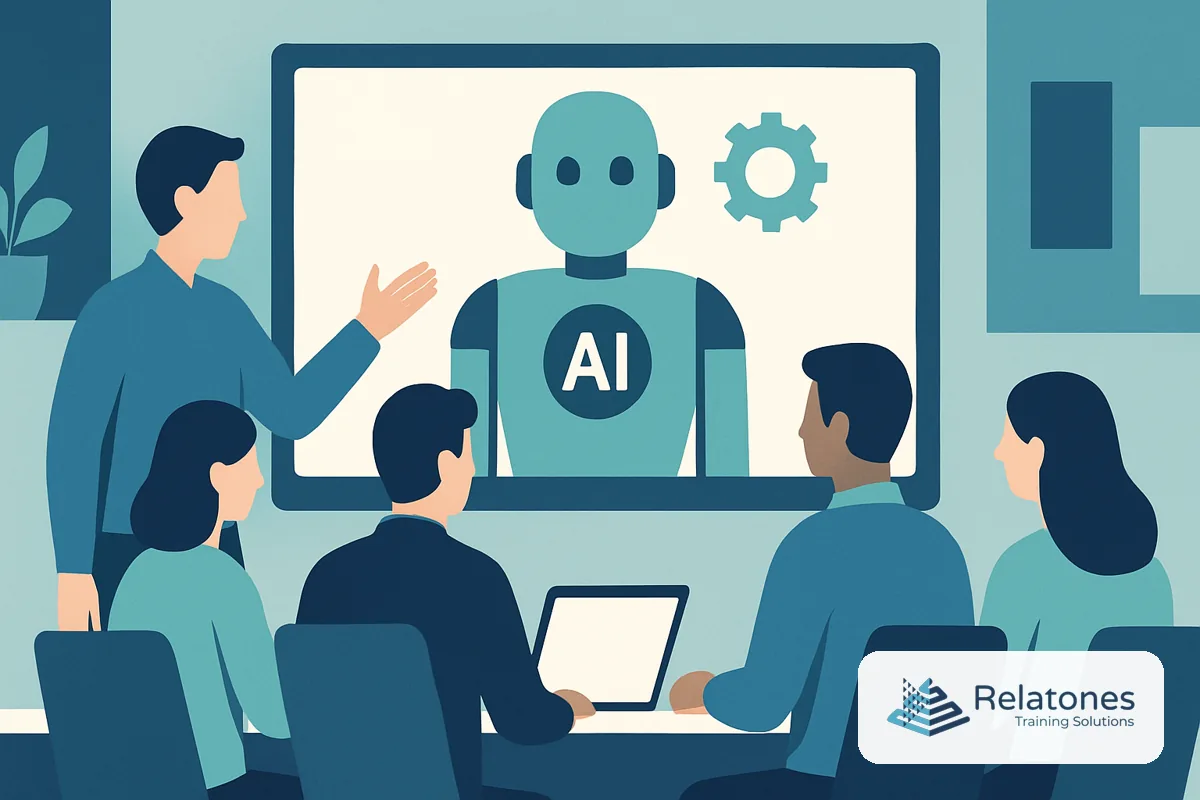
Virtual AI training for teams is structured instruction—delivered online via live cohorts, workshops, or on-demand modules—that teaches employees how to use AI tools inside their real daily workflows without requiring a technical background. It matters because over 75% of small business owners are already using AI, yet only 14% have fully integrated it into core operations—a gap that directly costs productivity and competitive ground. This article compares virtual and in-person formats across every dimension that matters to a 50–500-person company without an internal L&D team. And if your biggest fear right now is staff accidentally pasting something they shouldn’t into a public AI tool, you are not alone—that concern drives more training decisions than almost anything else.
New to building an AI skills program? Start with our complete guide to AI training for employees, or see how a session runs before you decide on a format.
Why Virtual AI Training for Teams Matters Now
The skills gap is real and widening fast. More than 70% of small business owners say their organization would benefit from additional AI training, yet fewer than half of US companies are taking active steps to train workers on AI tools. That asymmetry—widespread experimentation without structured learning—produces inconsistent results, policy violations, and wasted hours.
The cost of inaction is concrete. Teams that use AI without training tend to rely on ad-hoc, surface-level prompts that produce unreliable outputs. They paste sensitive data into consumer tools without realizing it. They build informal habits that are hard to audit and harder to standardize. When a regulator or a client asks about your AI policy—and RFPs now routinely include that question—an organization with no training record has no answer.
The upside of acting is equally concrete. 93% of small businesses already using AI report a positive impact on productivity and efficiency. National institutions are investing heavily: the U.S. Chamber of Commerce launched its Small Business B(AI)sics initiative with a $5 million Google.org grant aiming to reach 40,000 small businesses, and Google’s Grow with Google platform now offers seven courses designed to make entire teams—not just owners—AI-fluent. The window for easy competitive differentiation through AI skills is open, but it will not stay open.
What Effective AI Training Should Cover
Format is secondary to content. A well-structured virtual session beats a poorly designed in-person one every time. Whichever delivery method you choose, the curriculum must cover these areas to change actual behavior:
- How large language models work—and where they fail — Employees who understand hallucination risk and model limitations evaluate outputs critically instead of accepting them blindly.
- Effective prompting for business tasks — Context, role, task, constraints, and examples: a structured prompt framework produces consistently better outputs than trial-and-error.
- Critical output evaluation — Knowing when to trust AI and when human judgment is mandatory, especially for customer-facing, financial, or regulated content.
- Your organization’s data and acceptable-use policy — What data is permitted in AI tools, what is prohibited, and why—trained alongside the tools, not in a separate orientation deck.
- Role-specific workflows tied to two or three recurring tasks — Generic AI theory doesn’t change daily habits; applying prompting skills to an actual status report or customer email does.
- AI governance basics — How to document AI use, flag policy questions, and contribute to an evolving prompt library that the whole team can use.
For a deeper look at building a full curriculum, see our complete guide to AI training for employees.
How to Choose the Right Training Format (Step by Step)
The right format depends on your team’s size, geographic spread, budget, and how deeply you need behavior to change. Work through these steps before committing to a vendor or a schedule.
-
Map your team’s distribution — If your 80 employees sit in three California offices, in-person cohorts are logistically feasible. If 40% work remotely or across time zones, virtual is the only scalable option. Know this before anything else.
-
Define the behavior change you need — Completing a course is not the goal. Ask: “Which two or three recurring tasks should look different six weeks from now?” Behavior-change goals point you toward live formats—virtual or in-person—and away from self-paced modules as a primary vehicle.
-
Set a realistic budget per head — In-person training carries facility, travel, and facilitator-day-rate costs that can run 2–3× the cost of equivalent virtual delivery. For companies without an L&D budget line, virtual cohorts typically offer the better cost-per-outcome ratio.
-
Assess your data environment — If your team handles HIPAA-covered data, CCPA-regulated consumer records, or client-confidential materials, your training environment must use an enterprise AI platform with documented data-retention policies. Confirm this before selecting any vendor.
-
Identify two or three internal champions — Run a small pilot group of 6–8 people first. Champions test workflows, refine prompts, and co-facilitate later cohorts. This step works in either format but is especially powerful in virtual delivery where peer reinforcement happens asynchronously.
-
Choose your format based on steps 1–5 — Blended (virtual live sessions plus on-demand reinforcement) fits most SMBs. Pure in-person works when teams are co-located and the budget supports it. Pure self-paced is appropriate only as a supplement, not a primary program for AI behavior change.
-
Build a lightweight knowledge hub before day one — A shared prompt library, a one-page data-use policy, and a dedicated Slack or Teams channel for AI questions sustain adoption after the cohort ends. Set these up before training starts, not after.
Skipping steps 4 and 7 is where most SMB AI training programs quietly fail. Without a data policy and a prompt library, employees revert to ad-hoc habits within 30 days of the final session.
Assess My Team → Free. 10 minutes. No commitment.
The Format Decision Framework
Use this quick checklist before finalizing your approach. Three or more “yes” answers in a column points to that format.
| Question | Blended | Live Virtual | Live In-Person | Self-Paced Only |
|---|---|---|---|---|
| Team is geographically distributed? | ✓ | ✓ | — | ✓ |
| Primary goal is behavior change? | ✓ | ✓ | ✓ | — |
| Budget under $500/person? | ✓ | ✓ | — | ✓ |
| No internal L&D team? | ✓ | ✓ | — | — |
| Need documented training records? | ✓ | ✓ | ✓ | ✓ |
| Teams need to practice on real work? | ✓ | ✓ | ✓ | — |
Blended wins for most 50–500-person US SMBs because it combines the accountability of live cohort sessions with the flexibility of on-demand reinforcement. It also produces the clearest documentation trail—relevant if a client or regulator asks about your AI governance program.
Live Virtual is the practical default when teams are remote or spread across California locations. A 60-minute weekly Zoom cohort over four to six weeks, anchored to real tasks, drives genuine skill adoption. Americas SBDC describes this model as “the new competitive standard” for SMB AI capability building.
Live In-Person delivers the highest engagement per session and works well for leadership cohorts or high-stakes workflow transitions. The trade-off is cost and scheduling friction. It is worth the investment for senior managers or for a pilot cohort you want to turn into internal champions.
Self-Paced has a role—micro-modules between live sessions, a prompt-writing reference guide, a data policy refresher—but it should never be the primary vehicle for AI behavior change. Completion rates tell you nothing about whether anyone actually uses AI differently on Monday morning.
How Relatones Approaches Virtual AI Training for Teams
Relatones starts with a role-by-role workflow audit, not a course catalog. The goal is to identify two or three recurring tasks per job function where AI can save real time or improve output quality—before a single session is scheduled. From there, training is delivered in live virtual cohorts of 6–12 people over four to six weeks, with each session built around participants practicing on their actual work, not sanitized case studies. A one-page data and usage policy is trained alongside the tools in session one, so employees understand exactly what they can and cannot put into an AI tool before they ever open one. Between sessions, a shared prompt library and a peer support channel keep momentum going. By the final session, every participant has deployed at least one working AI-assisted workflow, and the team has a documented prompt library they own and can extend. The result is a measurably faster, more confident team—and an organization that can answer “yes” when a client or auditor asks whether AI use is governed and documented.
Frequently Asked Questions
Is virtual AI training for teams as effective as in-person training?
For most SMBs, virtual AI training matches or exceeds in-person results when it uses live cohorts, hands-on practice with real work, and a structured 4–6 week cadence. The key driver of effectiveness is not the room—it’s whether employees practice on actual tasks and get immediate feedback. Self-paced online modules alone, however, rarely change behavior and should be used only as a supplement.
How do we prevent employees from accidentally uploading sensitive data into AI tools during training?
Establish a one-page data and usage policy before training begins. Define clearly what data is permitted in AI tools—sanitized examples and internal documents with approval—and what is prohibited, such as personally identifiable information, customer records, and regulated data. Train employees on this policy in the first session, reinforce it in every cohort meeting, and use a pre-approved enterprise AI platform with transparent data-retention terms rather than public consumer tools.
How long does it take to see results from virtual AI training?
Most teams report visible time savings within the first two weeks when training is anchored to one or two recurring workflows. A structured 4–6 week cohort typically produces deployed AI workflows for every participant by the final session. Measuring outcome-based metrics—time saved per task, reduction in rework—rather than quiz scores gives you concrete evidence of impact quickly.
What should virtual AI training for teams actually cover?
Effective programs cover how large language models work and where they fail, how to write effective prompts for business tasks, how to evaluate AI outputs critically, your organization’s data and acceptable-use policy, and role-specific workflows tied to two or three recurring tasks per job function. Generic AI theory without workflow application rarely changes daily behavior.
Do we need an internal L&D team to run virtual AI training?
No. Companies with 50–500 employees and no internal L&D function run effective virtual AI training by partnering with an external facilitator, identifying one or two internal AI champions from a pilot cohort, and building a lightweight shared prompt library. The facilitator handles curriculum design and live sessions; champions sustain adoption between sessions through peer support and monthly show-and-tell meetings.
Your Team’s AI Skills Gap Won’t Close on Its Own
Every week without a structured program is another week of inconsistent habits, unreviewed AI outputs, and no documentation when a client asks about your AI policy. The format question—virtual versus in-person—matters far less than whether you start. Identify two workflows, pick one approved tool, set a data policy, and run your first 60-minute cohort. If you want a faster path, assess where your team stands today and let the gaps tell you what to build.
Assess My Team → Free. 10 minutes. No commitment.
Sources & References
Every statistic in this article is drawn from primary, US-based research. Explore the original sources below.
- 1Small Business AI Training Guide
- 2AI Training and Tools for Small Businesses
- 3U.S. Chamber and Chamber Foundation Launch Free AI Training Courses for Small Businesses Nationwide
- 4Why AI Training Is the New Competitive Standard for Small Business
- 5AI Training for Small Businesses Goes Nationwide
- 6Superagency in the Workplace: Empowering People to Unlock AI's Full Potential
- 7Small Business CO — AI Training Resources
- 8AI for Small Business — Online Courses